George Grylls Writes The Most Dishonest Piece Of Election Coverage This Whole General Election (And That’s Against Some Pretty Stiff Competition!)
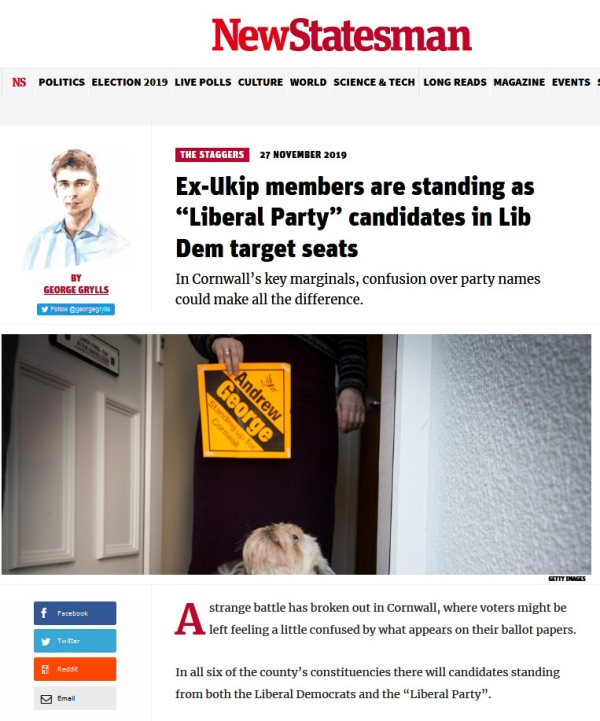
Like, WTF?
There’s been some dishonest, biased and downright distasteful claims in this campaign, but George Grylls sour grapes piece for the loyal Labour lapdog New Statesman (it likes to think itself as ‘liberal-socialist’ – however its self-gagging during Tony Blair’s red Toryism makes that risible) regarding the Lib Dems looking set for a bloody nose down Cornwall way again – and it’s all a bunch of Kippers pretending to be liberals fault – scraps the barrel.
Of course, you should never trust anyone called George anyway. They will come invariably from the cuntier parts of the middle class, along with Jasons, Justins, Nigels and Tristrans. But this is undoubtedly the worst example of leaving out inconvenient facts to suit a journalist’s own bias.
Putting the term Liberal Party in parenthesis as Grylls has done is to give the impression that the poor little Lib Dems are about to be ‘cheated’ at the ballot box ‘Literal Democrat’ style again by electoral skulduggery is simply ignoring electoral facts and history to suit one’s own prejudices.
The Huggett case
One of the longest self-pity stories in British politics is the Liberal Democrats claim that voters were ‘tricked’ into voting for one Richard Huggett in the 1994 European Elections when he stood as a Literal Democrat, taking over 10 000 votes and so ‘costing’ the Lib Dems a seat they would have ‘won’ from the Tories.
Additional versions of the story claim Huggett’s candidature was part of a family feud. Others claim Huggett received a hero’s reception at that year’s Official Monster Raving Loony Party conference in Ashburton, Devon; as if all a put-up job (the conference spot being the Golden Lion Hotel, owned by OMRLP Chairman Alan Hope, a former member of his local Tory party).
The much repeated version of the story fails to mention the Lib Dems going to court before the election to stop Huggett doing so, but the case being thrown out by Sir Justice Thayne John Forbes (later to preside over the mass murderer Dr Harold Shipman trial), which only succeeded in giving Huggett the media publicity hitherto he’d only dreamed of for his campaign (based around ‘computer democracy’ – years earlier there had been a number of ‘Computer Democrat’ candidates, one of whom was arrested for attempting to tamper with electricity pylons).
It also failed to mention such stunts had been happening for years, with renegades changing their name by deed poll to that of sitting MPs, and none had ever worked. A certain Roy Jenkins won Hillhead in 1982 despite there being two Roy Jenkins, both for different Social Democratic Parties, on the ballot paper.
Most damning of all, it failed to mention that the Liberal Party’s David Morrish – a local County Councillor – had finished in fourth with over 14 000 votes. The Lib Dems had lost because diehard West Country liberals stayed with what they saw as the true original party, not the merged one.
A bluffers guide to the Liberal Party
The Liberal Party in its present form have been around since 1989. Like the continuing Social Democratic Party, it was made up of those members who objected to the Liberal-SDP merger after their 1986 general election trouncing.
The continuing Liberals had even more reason than the SDP rebels to be aggrieved: the Liberal Party’s structure meant it was controlled from the membership upwards. But the party’s leadership at the time, under David Steel, wanted to flip this on its head, and have the party controlled top-down, same as the Conservatives, and same as Labour was learning the hard way it needed to adopt to stop local ‘mavericks’ bringing the party into disrepute.
But the Liberals had little reason to do so. It had no major financial backers it needed to keep happy, almost all party money was raised by activists and any in salaried political office had to tithe ten percent of that wage (a concept stemming from the party’s roots within the non-Conformist churches).
It also did not suffer the Conservatives or Labour’s problems of ‘affiliated’ groups being loose cannons or even trying to impose their own hobby horses on national party policy against the mass members’ wishes – as happened to Labour with the Trotskyite front Militant Tendency and the Tories with the Monday Club’s dalliances with the National Front. This had been the major reason for the two major British political parties becoming more centralised, not merely a wish to become more ‘professional.’
Finally, the Liberals saw this – perhaps a little ironically in the circumstances – as the SDP taking over their party, with their party structure being the proposed template for the proposed Social and Liberal Democrats. The idea of becoming a party where their purpose was to do as they were told by their ‘betters’ was the antithesis of everything they believed a political party ought to be about.
Much as the continuing Liberals and continuing SDP hated each other, both were united in belief that the ‘Salads’ (as they referred sneeringly to the old political allies they left behind) were unprincipled careerists wanting to create a British version of West Germany’s Free Democrats (the bastard child of the pre-WW2 Democratic Party and the People’s Party of the legendary Gustav Stresemann – arguably Germany’s greatest democratic politician of all) which had been the junior partner of almost every Bundestag post-war government.
The whole future strategy for the new party appeared nothing more than becoming a wishy-washy official party for disillisioned Labour and Tory supporters’ protest votes, waiting for the day when – by the law of electoral averages – they’d get into government as the coalition partner of one or the other in return for proportional representation in all future elections – putting them into government almost forever as the minor coalition partner of choice.
To those who believed in liberalism as an ideal and ethic, not merely a party brand name, this was equally as intolerable as it was to those who believed in social democracy now watched in disbelief as the Trotskyite Labour Party still shrilling calling their old SDP friends ‘traitors’ morphed into All Things To All People With The Franchise without the merest blush.
So it came to pass in areas such as Liverpool, the Marches, Yorkshire and especially Cornwall and Devon, the Liberal Party continued in a small but highly resolute manner ever since, and has never been without representation in local government at a minimum District/Unitary authority tier.
They also hate the Liberal Democrats with a passion as illiberal undemocratic imposters epitomising the cynicism of modern politicians towards electorates.
Catching the kippers
It’s no surprise that the collapse of UKIP as it transmorphed into a Diet BNP led to horrified local members defecting as a group elsewhere to other Eurosceptic parties. It is also no coincidence that the two maverick ex-Alliance parties have proved the most attractive proposition: the United Kingdom Independence Party (formerly the Anti-Maastrict League) was founded originally by Professor Alan Sked, a former old Liberal Party parliamentary candidate; and the only reason the original SDP had been pro-Europe was by the diktat of its first leader, Roy Jenkins, previously the head of the European Commission.
In Sheffield and Leeds, it was the Social Democrats who picked up the original defectors. It should be no surprise that for geographical reasons, the ex-Kippers in the West Country should turn to the Liberals.
It is also somewhat rich for any Lib Dem to complain when over a third of their entire Parliamentary party consisted of people who had defected or been expelled by other ones – in some cases people on their third or fourth party in a single year!


 AA42
AA42 AA6x7
AA6x7 The Mare's Nest
 6s & 7s
 Skeletal Screams Blogspot
