Thief (2014) : Worth The Candle? (A Review)
There’s been a lot written about the long overdue release of Thief 4, which became a reboot of the Thief series altogether.
Or maybe it wasn’t.
It all depends who you ask, and seldom has a game so divided opinions before it was even released (except, perhaps, Sims 4). Released at the tail end of February this year, reviewers and fans alike either loved it or hated it.
With Thief: Deadly Shadows being one of my all time favourite games, I was always going to give this one a try. Here’s my own thoughts and impressions.
First the basic plot without giving too much away
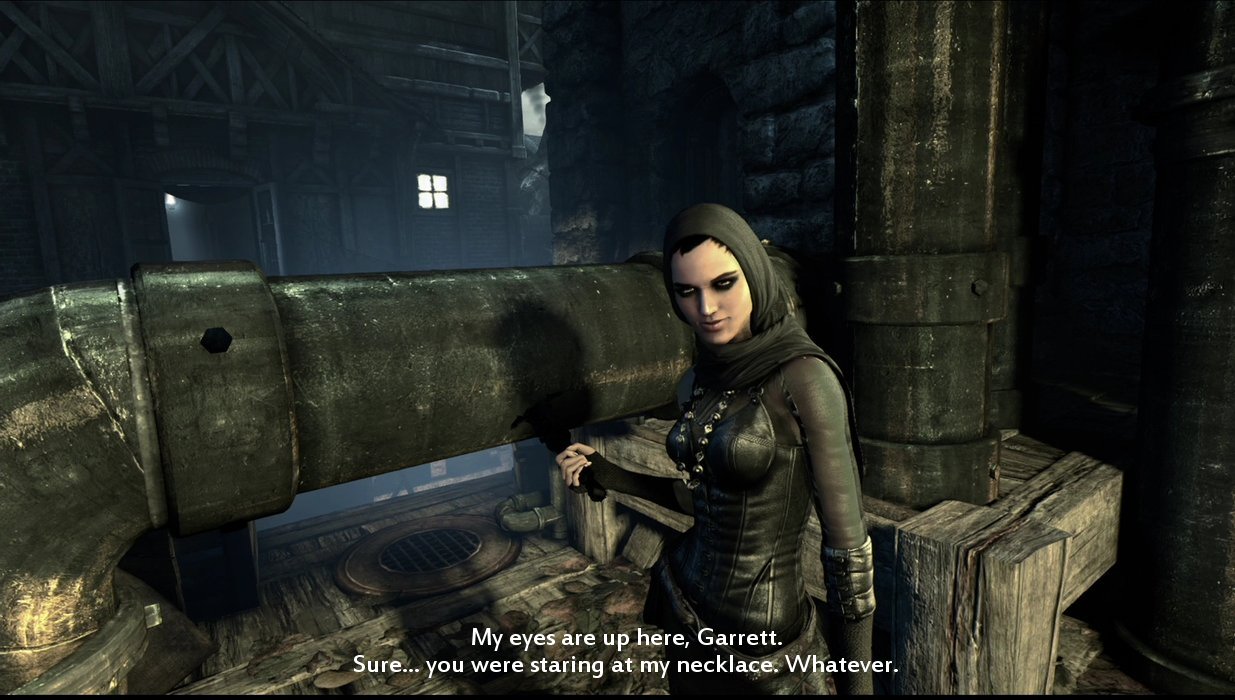
Garrett is stil the master thief with the funny right eye, stuck in The City trying to piece together his life after twelve months has been blanked out of his memory, the last of which he remembers was being responsible for his brash and rash protégé Erin being killed after stealing her climbing claw during a job in order to teach her a practical lesson on stealth, falling onto a bunch of worshippers whose ceremony they messed up big time as they conjoured up… something.
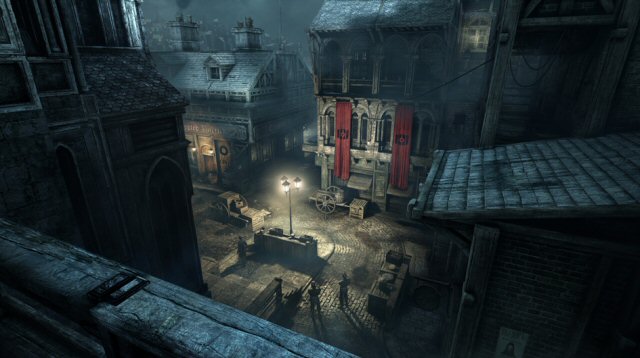
Times have changed: the early modern feel The City had before (circa our own 17th century) has jumped forward to a steampunk early industrial sprawl, the mixture of old fashion torches with more modern street sconces and electric lights from street to street no matter what the district showing this advancement to have been fairly rapid, and those who remember Thief: Deadly Shadows with affection may mourn what The City has become. Even the pretty fountain of South Quarter has been demolished to make way for ‘progress’.
Spending so much of the game clambering about the rooftop, the player will get a first class view of this, as about everything above ground floor level has been ramshackle hammered together (often on top of existing stone structures) with nails and wood for speed. The Hammerites, Pagans and Keepers are all gone, the City having outgrown them and in their place is the materialist iron thumb of Baron Northfleet.
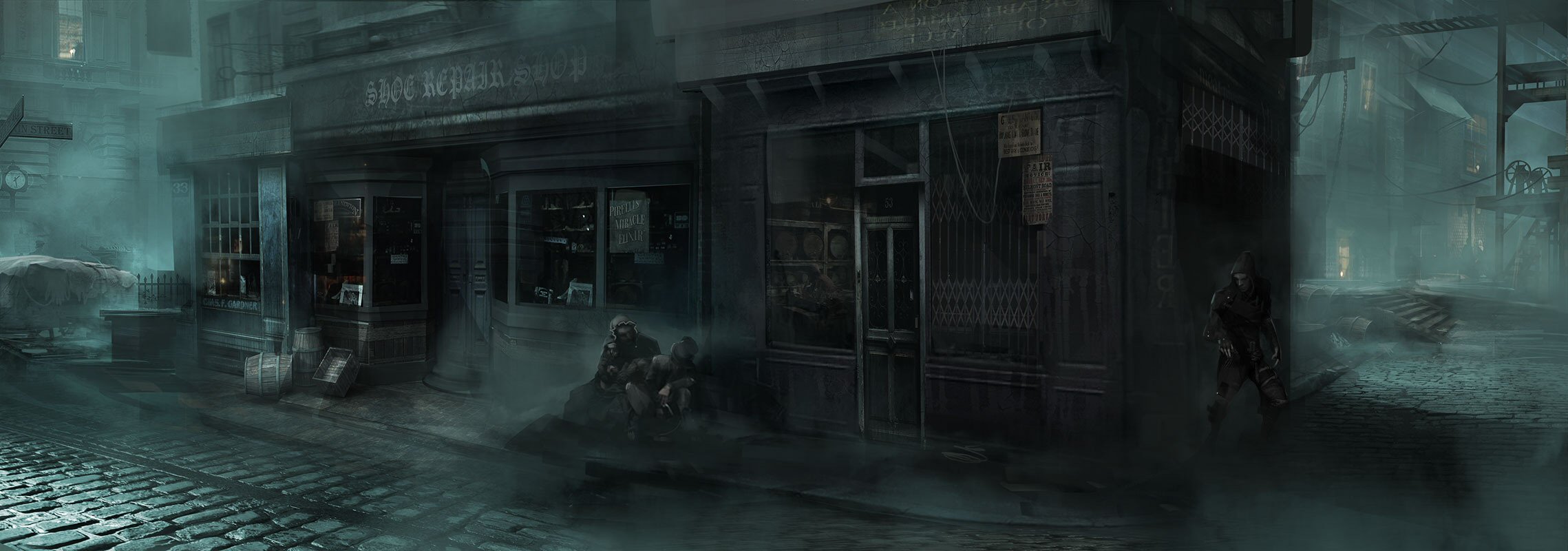
Trouble for him is the iron’s starting to crack. Even the more tyrannical of rules cannot control the bane of all cities – a pandemic – and the once over-crowded poverty stricken city has seen hundreds daily dying of The Gloom, their bodies hauled away by the cartload to be processed on a production line in ghastly Auschwitzian manner into candles and more sinister items besides. Those not dead starve for bread and work, the only two major sources of employment being stealing or being a member of the Watch out to stop them.
The City is ripe for rebellion: whilst the poor starve and die in the gutters and crowded shanty shacks, the wealth and powerful have time to spend on luxuries and in the decadence of Madame Xiao Xiao’s House Of Blossoms’ pleasure house. In the void of despair a rabble rouser called Orion and his messianic Graven followers promise to overthrow the City’s ruling class and cure those suffering from the Gloom which has defied what primitive medical expertise exists.
Garrett as always wants nothing to do with local politics. All he wants is to piece together the missing twelve months of his life, which means naturally he is once again doomed to find himself taking centre-stage in City politics.
Game Play
Learning how to get from one side of the city to another is the toughest part of the game.
Much of this has to be done not through the traditional gates, but via cutting through houses via those glowing blue window you discover is a portal only when the game switches to another load screen, with a handy game tip while you wait but in a font so small and blurred to be barely readable in the short time snap allotted to view.
The new City is realistic to a depressing degree for the period. There are few discernable landmarks in such a hastily constructed sprawl, especially above ground level, and much of your moving about has to be done over rooftop passageways and beams to cut through houses.
The main reason for this isn’t only for accessing certain portals to district sections, but due to the City Watch now going in groups of two in many areas so you can no longer simply bop them and dump them out of the way (spoilsports!).
This makes getting around the tightly packed streets and from district to district very much a matter of memory – repetition, repetition, repetition, wandering around each district in turn until you know your way around by heart – down this street, along this roof area, through this house and so on – but once you’ve looted every house in a district (which do not respawn – only the lit candles do), there is very little incentive left to do so, which can make for a bit of a learning curve unless you are prepared to be patient.
It would have been good had the makers introduced a marker system, allowing the player to mark some sort of symbol on buildings and walls only visible to Garrett (like the glyphs of old) – but that would have required Garrett having his special eye being special. He keeps the zoom from it in game, sort of, but without the explanation as to why he has it.
This is another of the game’s jarring points – much of the old game canon is trashed whilst alluded to paradoxically. Gone are the Hammerites (although the Baron who is your nemesis this time around hints of their Mechanist faction from The Metal Age), as are their rivals the Pagans. But Basso from the first game returns (older and fatter) and a nephew of Parry the fence replaces Garrett’s original ally from Thief: Deadly Shadows – although this time as someone to rob.
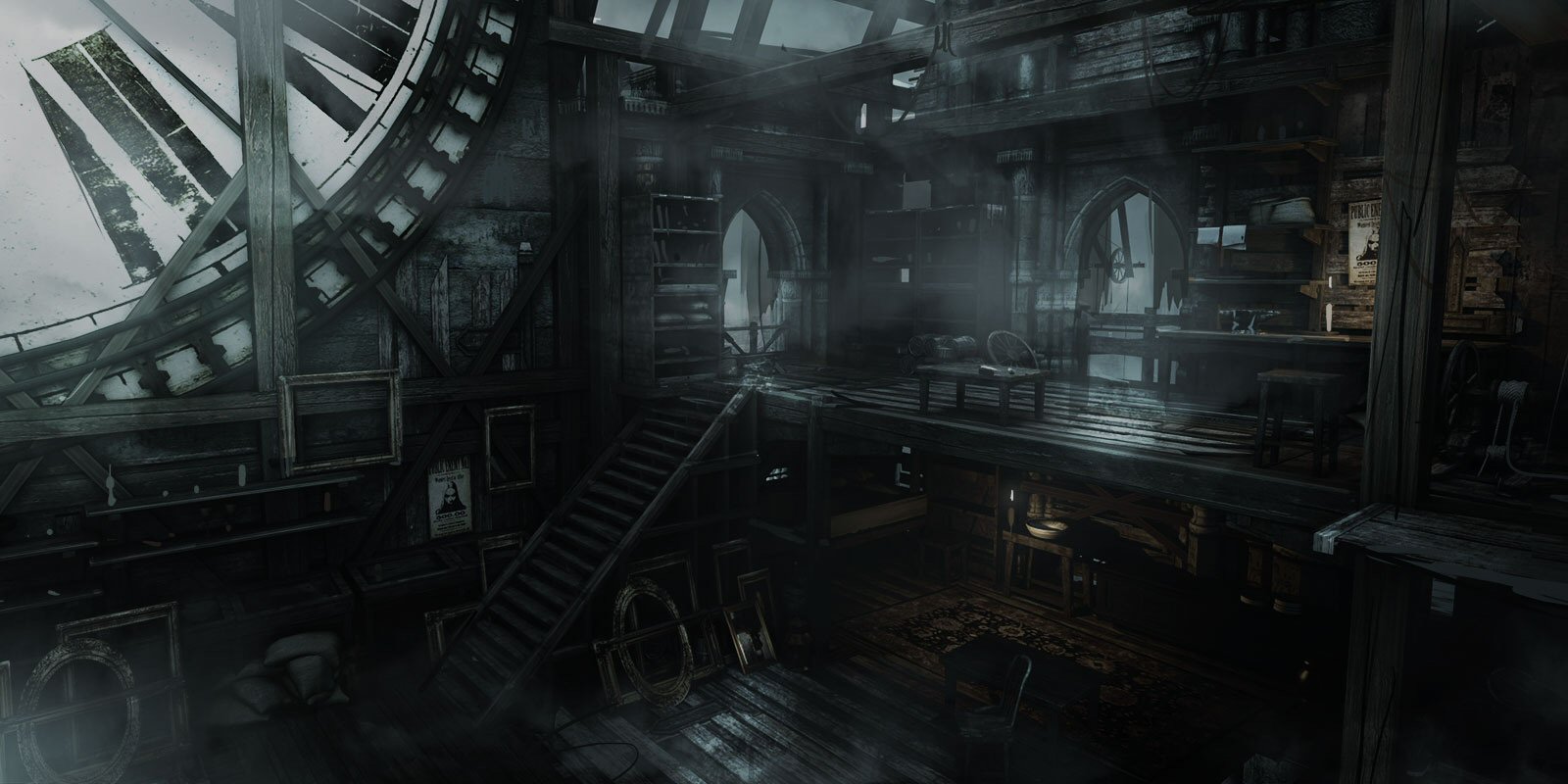
It is a nice touch that Garrett’s home is in the rebuilt clocktower centrepiece of The City, considering his part in accidentally destroying it last time out. There’s also a spectacular cameo by Edwina Moira, last found seated at the top of Overlook Mansion, insane with grief and asking for some wine, but let’s not spoil the surprise on that part!
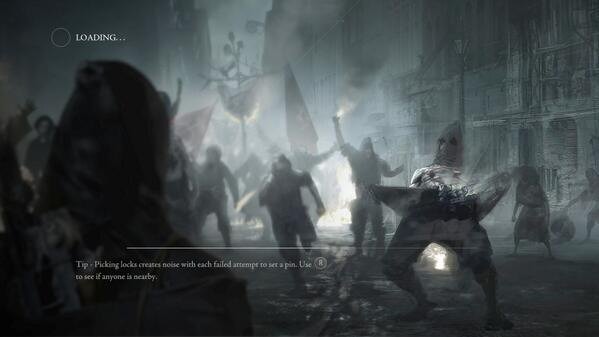
A typical Thief (2014) loading screen. You have 30 seconds to make it out and digest it, or you can instead solve the following appropriate Countdown conundrum: B C K L L O O S.
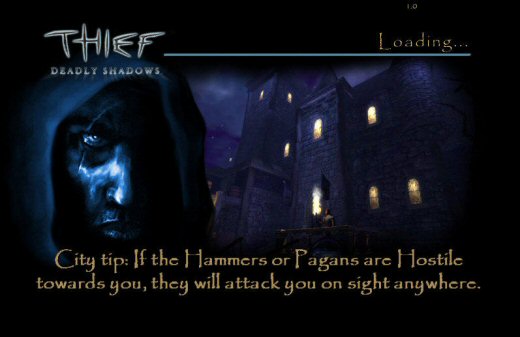
The atypical Thief: Deadly Shadows loading screen ten year prior. Note ease of readability.
The loading screens
In this day and age going through so many loading screens would be tiresome to anyone without a top of the range rig for quick loading. Here’s the paradox: it’s clear the districts have been cut down into chunks to reduce the minimum specs required.
Considering how long it has taken Thief 4/Thief (2014) to come out, you can understand Eidos Montreal’s desire to attract as many buyers as possible to recoup the time and capital invested in its stop-start-stop-start creation, but there’s times when manufacturers have to say ‘taffer the multitudes’ and refuse to cut corners – especially in the post-Skyrim, post-Grand Theft Auto Five gaming market where dumbing down is no longer an option.
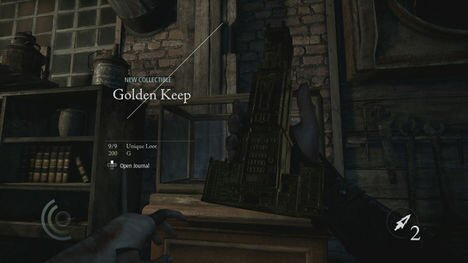
Garrett’s new move is to manufacture plastic replicas for sale in the seaside shops of Illyria.
Loot
There has been much talk elsewhere about there being too much loot in the game – I disagree. Unlike Thief: Deadly Shadows (the previous open ender), the minor loot doesn’t respawn after certain game stages have passed. As said earlier, not only is this a disincentive to go round the houses again, it makes money very tight as you try to upgrade – and you will need to upgrade, especially your ability to fall without taking damage and being able to carry more arrows. Basso offers you extra jobs, but the money made from them doesn’t go very far.
Later on in the game there are items for sale costing ten to twenty thousand pieces of gold. There is no way this can possibly be earned at the normal level even if you took every piece of loot from every home, every chapter job and every side job, and what the purpose is of these redundant extras is anyone’s guess. Is this with view to earning them via expansion packs for Thief 4 later?
Forget what others may claim, it is impossible to go through this game without needing to replenish your arrows or upgrade your equipment. Even for the ultimate stealth warrior, the turning point is Moira Asylum halfway through – forget heading out there unless you have upgraded your quiver at least once to take extra fire and explosive arrows with you.
Worse, the ordinary citizens appear not to have a brass farthing between them – the very ones by logic you ought to be robbing. Instead, if you want to make some more money, you need to clobber the City Watch, the Eelbiters (South Quarter’s bandit gang are called) and later Orion’s Graven. It makes no sense that your mugging or pickpocket targets are the armed gangs patrolling the streets rather than the unarmed and well-heeled.
In fact, the first pursed citizen I found waiting to be mugged or pickpocketed all game only appeared after I’d completed the whole damn game and was heading back to collect the Golden Keep reward from the workshop during my post-game tidy up. Stoooo-pid!
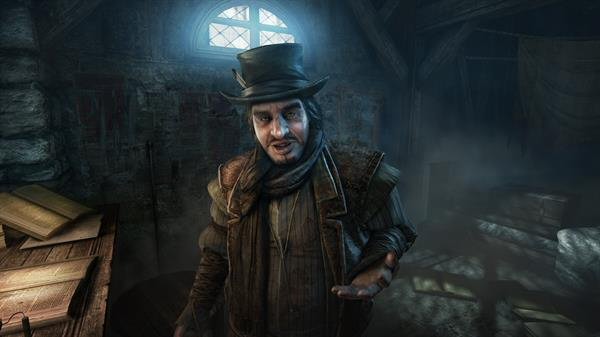
Basso is what Aurelio Voltaire would have become had he become addicted to Fried Twinkies.
The Fences
In Thief: Deadly Shadows, much of the fun was the obligation to run around each fence and shop in each district (ranging from partial partner in crime Perry and flirtatious Bertha to dour Dahlia) as some only took certain types of loot or sold certain items; obliging the player to go from district to district beyond the requirements of missions (dodging the ever present City Watch in the process).
Now the fences have to all purposes gone: replaced by Basso the Fence who does no fencing. He is more like M to your 007, providing you with extra side missions, as do the mad inventor Ector and the Mayor of Imaginationland lookalike Vittori.
The role of the fences and shops instead are merged into grubby little spivs in or near taverns or in dank basements offering you the opportunity to buy and sell equipment. Save for collectable loot, all the other loot gathered is automatically converted to gold in-game. It speeds things up, but it seems strange that Thief (2014) of all games should junk the very Shop and Fence system Thief: Deadly Shadows introduced in 2004 that remains an open world game standard to this day.
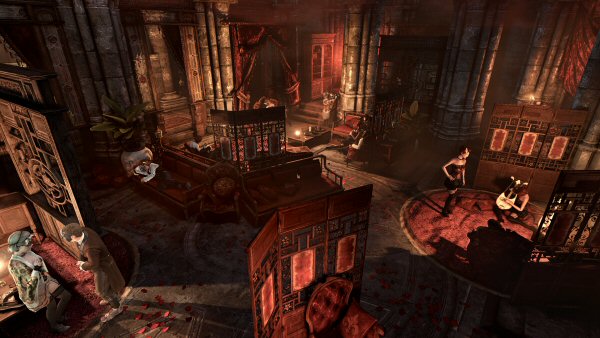
The minute you walked in the joint, I could see you were a Tory backbencher or a Cabinet minister…
‘Thief Is All Grown Up And Stuffs’
In the previous games, the characters would ‘taffer’ everyone and everything all taffing night long. It helped give the game its unique character and brought a smirk every time a character used the Taffer word. Now the game is peppered with the F-word like an American B-movie instead, and this wonderful word is consigned to gaming history and The Mare’s Nest‘s mentions of members of Boolprop Fight The Addiction False.
The foul language jars, and added to the brothel it give the game an air of some pubescent trying to be edgy and 18 plus so much it pains to watch. Whilst the brothel itself is harmless enough – decked out like Kubrick’s ‘Eyes Wide Shut’ meets Dolly Parton’s ‘Best Little Whorehouse In Texas’ (with the end ironic result that it more resembles an old fashioned cinema) – the voyeur scenes seem more about titillating basement dwellers than having any real purpose to the game: the symbol spotting requirement to crack a code smacking (excuse the pun for those whom have passed that part of the game) of a laborious attempt to justify their inclusion. Come back Porky’s, all is forgiven.
There’s also the now dopey mandatory video game requirement to include some sort of narcotic drugs reference: Garrett having to eat poppies to restore his Focus (an idea that appears copied from Far Cry 3). Um, wouldn’t poppies have the opposite effect, especially when sabotaging an opium pump connected to the ventilation (yes, this part of the game is based on fact!) allows you to render unconscious an entire building later in the game?
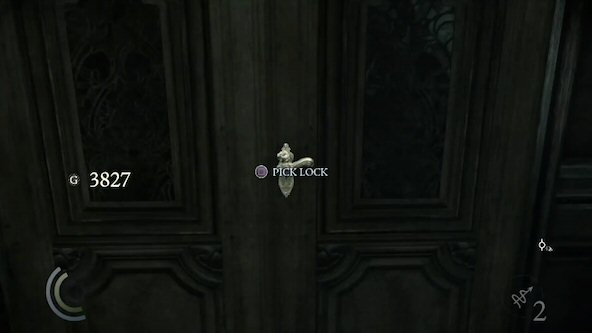
Pick your nose while at it and see which is the more fun. My money is on the latter…
Lockpicking
It is incredibly easy to lockpick, a mile easier than Thief: Deadly Shadows and light years easier than the locks faced by Skyrim’s thieves (whose costumes more than took a nod from the Thief series, and now have the favour returned in the 2014 edition). With your lockpicks never breaking nor there being any penalty for pushing a pin into the lock incorrectly either (other than having to restart that pin) it makes for easily the poorest part of the game – they may as well not have bothered – and for a game which brought the idea of lockpicking into video games, this is beyond tragic.
The only part of the game worse than the lockpicking has to be the sound. Far too often you can find two sets of voices talking over one another, making switching on the subtitles in this game compulsory.
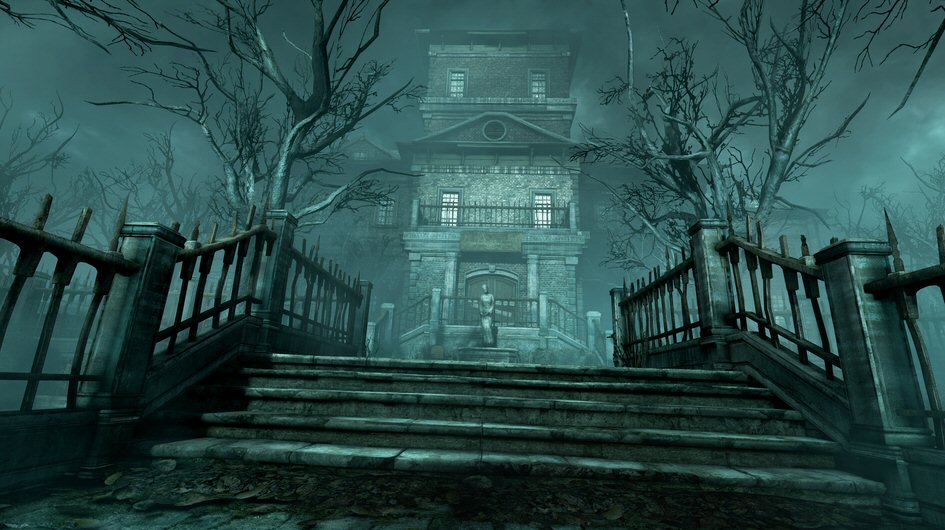
With trees and flowers and chirping birds and basket weavers who sit and smile and twiddle their thumbs and toes…
The Moira Asylum
The Moira Asylum (the chapter called ‘The Forsaken’) is without any doubt the make or break point for Thief 2014.
Many unhappy with the new version of the game will persevere doggedly to this point solely to find out whether the Cradle’s successor holds a candle to the original: but only after putting off playing it with side mission excuse after side mission excuse not to.
That is the central core to the Thief legacy, in particular the legacy of the Shalebridge Cradle. Ten years on it remains a video game legend, and rightly so.
The way fear is utilised is central to the Thief series – not by the standard jack-in-a-box ‘BOO!’ methods loved by Far Cry’s Trigens or the various incarnations of Half-Life, but by playing on the player’s sense of vulnerability without resorting to the tedious middle game Capture By Baddies – Escape Penelope Pitstop Peril- Irretrievable Loss of All Equipment video game cliché.
When stealth is your main weapon and wealth your goal, travelling light is a must – and it was that sense of being unable to defend yourself (you had to get your blow in first without being spotted, and if that failed to immobilise your enemy first time you were in big trouble) that made for the merest looming shadow, advancing glow from a torch or even the flickering of an electric light feel like an incoming threat.
Over and above this, Thief games always have a ‘scary bit’ since the impact the Haunted Cathedral had on players and reviewers alike. In Thief: Deadly Shadows, near perfect timing of these moments made for a near perfect game. Thief (2014) was always going to have a lot of living up to do.
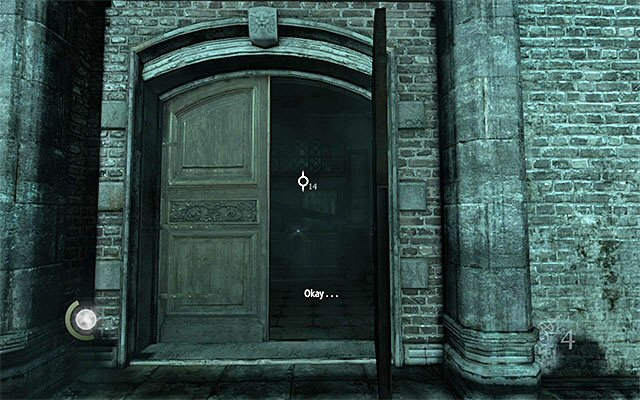
Feel free to say ‘I want my mummy’ at this point.
Which brings us to the Moira Asylum, the successor to the abandoned Shalebridge Cradle and as you may already have guessed from the boat trip to get there built out on the island where the Overlook Mansion of the Widow Moira once stood (the more alert will notice some similarities on the outside).
It’s here that Edwina Moira makes her cameo in the game, not merely as the statue outside – and it’s a real knockout. If you played Deadly Shadows, you may well find yourselves creasing up with laughter at this one. Yes, laughing in the scary level. It is a beautifully executed set piece, and kudos to the makers for it – straight out of the M.R. James canon or Susan Hill’s ‘The Woman In Black’.
But before going any further, let’s mention the following often touted picture at this point in reviews:
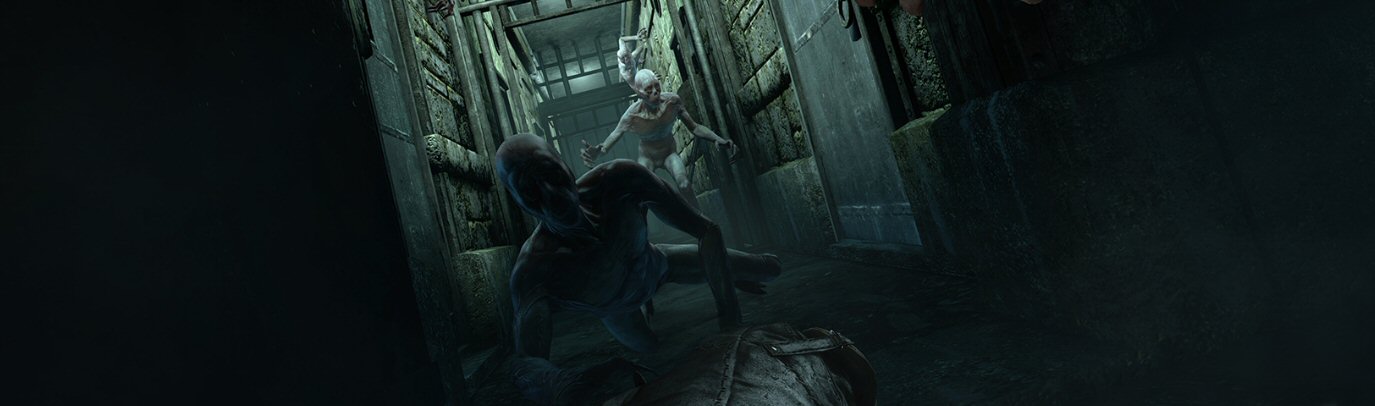
It’s a cinematic cut scene far from representative of game play, and in all honesty a predictable yawn.
These ‘gloom walkers’ as they are called do some cameos throughout the game before making their big entry at the latter stage of Moira Asylum. Although you really don’t want to get into a scrap with them (two punches from them and you’ll be harp playing) they burn like potassium and have one other major weakness (but you can figure it out for yourselves!). They’re more of a nuisance that a real heart-thumper – and the Moira Asylum has a carefully selected few of those. In some ways the gloom walkers come as a relief when they appear – a tangible, predictable flesh and blood foe of no question.
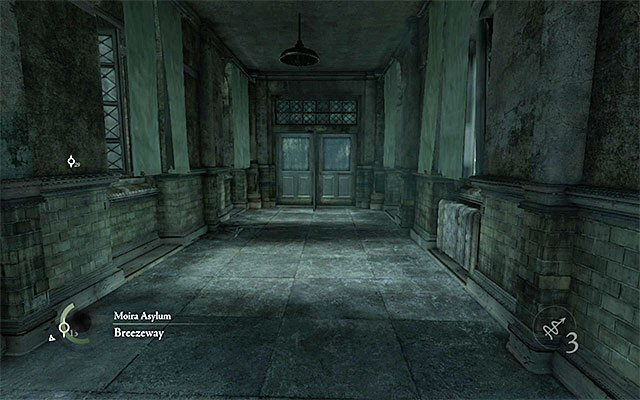
Like the Cradle a combination of judicious timing of sound and events coupled with toying with the player’s natural hesitancy to be scared makes for a real triumph as the gaming world of Thief (2014) you have known up until now is turned on its head.
Something unnatural opens the door to let you in – thereafter you are faced with nothing but closed door after closed door, and where before there was a comfort in having a keyhole to peer through to see if it was safe, now the prospect of peering soon takes all your resolve to do so and stay looking at the screen.
Long empty corridors lit by the daylight streaming through the plentiful windows (in line with later designed psychiatric buildings as hospitals, not prisons) play on your vulnerability as another inexplicable sound is heard… and was that far away or near? This is the one place in the game the sounds are perfect (and yes, there is speech) and you will forgive the inglorious mess made of the City sounds for getting it so right in the Moira Asylum. Perhaps.
There are a host of other clever, clever set pieces, too numerous to mention – ah, but you will have to be quick to see them in some cases, you may fail to spot them indeed at all first trip in (if you ever brave a second one!) – proving the old adage of simplicity being for the best, and that there’s no ghost story like a traditional ghost story.
The Moira Asylum differs from the Shalebridge Cradle in dipping into traditional ghost story lore for its terror. As you discover from those documents you find around the asylum piecing its story together, it was a different kind of mental hospital making for a different (but at times not so much different) experience, leaving a different kind of imprint on the decaying stonework. The Cradle reflected the horrors of the early real life Bedlam, the Moira Asylum those bumbling moves towards proper psychiatric care institutions rather than ‘loony bins’, and all credit to Eidos Montreal for once again making a faultless snapshot on a dark part of human civilisation’s history.
It also harks back to the Shalebridge Cradle from another angle – the Cradle was long abandoned, left for decades to become transmogrified by the lingering miasma of its legacy of misery if took a life of its own from all the death and suffering within its walls. Moira Asylum by contrast is recently abandoned, a snapshot of what the Cradle may have been after its tragic end, somewhere that with the right will some good could have been salvaged from its tragic end. In both cases they beg the question why nothing was done, and the uneasy answer returns because The City doesn’t care a fig about the mentally ill. The Moira Asylum by its very nature was build so the Cradle would be forgotten – and the mistakes that led to its fiery pyre doomed for all Edwina Moira’s hopes to be repeated.
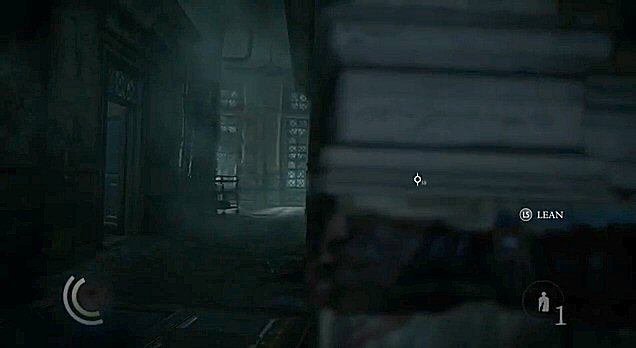
Peering round the corner as the Night Warden approaches – is that a skull forming in the gloom?
The most terrifying moment of the whole game was for me the non- arrival of the Night Warden. You really have to experience this part to realise why it is the truly scariest part of the whole bloody game, why once you have all you came for you will run for your life away from that area, away from that shimmering presence, who growls if you look at it through a keyhole, and gives you one almighty thump should you be stupid or unlucky enough to get in its path.
The Night Warden encapsulates the thuggish authoritarianism of the Moira Asylum imposed – as in most of such places they tended to be – by the more brutish members of society with little qualms about unrestricted violence to make patients obey. For all its more enlightened approach, there are rules to be followed and transgressions are mercilessly punished.
The player will grow to hate and fear the whump-whump, whump-whump heavy boots stomping the corridor, begin to appreciate why so many of the ghosts espied through the keyholes do little more than shake and sob in petrification. Even in death, they are not free from the Night Warden, still enforcing mulishly the rules of an abandoned institution beyond the grave upon anyone living or dead that crosses its path.
It contrasts with the flip side, as you hear (and more!) earlier the voice of a long dead nurse soothing some unknown patient – a reminder that some at the Moira Asylum tried so hard not to let it be another Shalebridge Cradle, yet failed.
Some say the eerie dream-or-isn’t-it part come the conclusion is scarier (a sequence that is part Dr Who‘s Weeping Angels, part The Signalman). Me? Personally I found that part ethereal rather than eerie, besides at that part I was far too busy cheering the Asylum’s former residents as you learn their final fate before the Asylum door slams shut on you – its tale told, and with you now as its living witness sent forth to do what you now know you have to do, if its story is not to be in vain.
It is a part of the story you leave with a sense of relief, triumph and wanting to applaud those at Eidos Montreal for a chapter brilliantly executed. If you had any doubts about the game before, it also leaves you more than happy to continue to the conclusion.
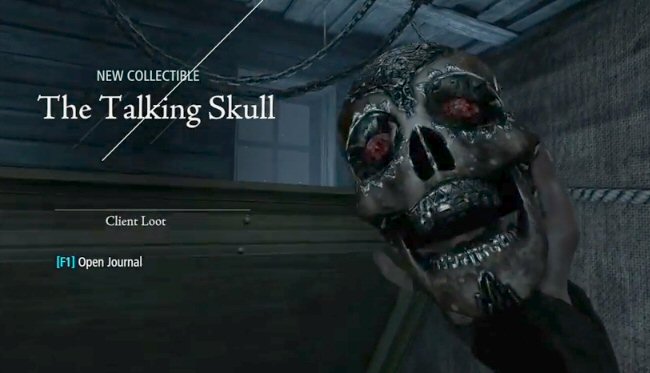
The Talking Skull
The side-missions – far too few in number – vary from run-of-the-mill to good fun (especially the last Virotti mission!), but a special mention must go to The Happy Medium mission for Virotti. As mentioned before, Garrett is tasked with not merely following bumbling sot Lenny waddling back to his hideout, but keeping him going. All manner of high jinks ensure as he strives to retrieve the stolen Talking Skull.
Once you come face to face with the skull itself (with rubies in its eyesockets – looks like someone at Eidos Montreal loved the eponymous 1984 3D maze computer game!), far from possessing some dark menacing voice of doom sounds like sounds remarkably similar to M’aiq the Liar, principal loony of the Elder Scrolls series. It’s hard not to take an instant liking to it and wishing you could keep it for yourself. That said, if dealing with Lenny isn’t bad enough, trying to make your way out with the skull betraying your presence to everyone within prediction range with his bòn móts is enough to drive even Garrett nuts in the process. Along with the Moira Asylum, my favourite part of the game.
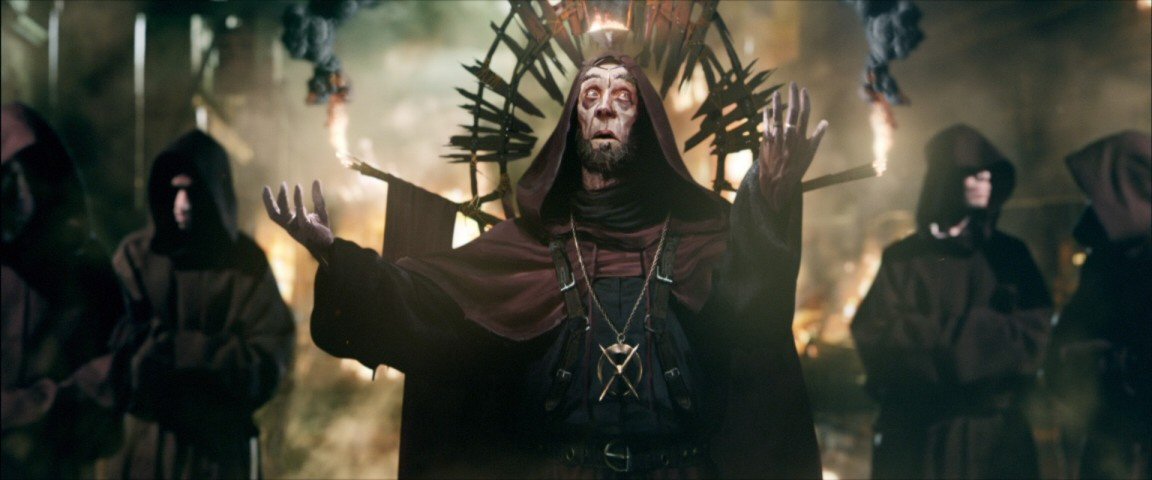
‘I am the god of hellfire, and I bring you… um, prompt!’ As the monks would say, nice video game, shame about the plot!
The Rest And Final Thoughts
From Moira Asylum onward the chapters get better and better, and apart from the dreadfully disappointing rushed ending (all that build up for something even weaker than Half-Life 2 – Episode 2) it proves to be a highly enjoyable – if all too brief – return of Garrett (whose new voice actor you could easily mistaken for the original with ten years on him). After the Moira Asylum, I’d high hopes for the return of the Haunted Cathedral, but old Father Time has been so cruel to it you’d be tempted to call social services – wrecked beyond repair and a shadow of its former malevolent self. Perhaps we will see it repaired and restored in future outings – if there are future outings that is.
Over the 19 hours I took to play it, I found there are plenty of tricks and puzzles to figure out (two of which from memory were downright bloody fiendish to complete, whilst the entire bonus Bank Heist level will drive you demented!), and once you have gotten familiar with The City layout, you can enjoy experimenting with different approaches to the game and dealing with opponents. But… once the game is over, that’s really it. Apart from starting from scratch or doing the challenge levels, there is little incentive to continue, and the modders will need to come to the rescue here unless there are plans for expansions.
Thief( 2o14) is a game that will annoy you and charm you, delight you and frustrate you in equal measures. Over the piece I would recommend it, but I would also recommend you take your time to enjoy the game properly. Learning to love The City again, and what it has become, is part of the key of learning to love the new version of Thief, which could prove plenty of fun if Eidos Montreal stick with it.


 AA42
AA42 AA6x7
AA6x7 The Mare's Nest
 6s & 7s
 Skeletal Screams Blogspot
