Who was Frank Sidebottom (who he was, he really was)?
The following is for the benefit of anyone living outside of mainland U.K (except for the Isle Of Man who were plagued with appearances by him more often than most care to remember), who may be wondering what the bobbins the latest custom content download bundle refers to. Or maybe not.
By way of explanation, it was done because the simplicity of most of the artwork to Frank’s stuff means it looks nice when transferred to a Sims 3 environment.
But the song ‘Greengrocer On The Corner’ is nice. You can hear it on YouTube.
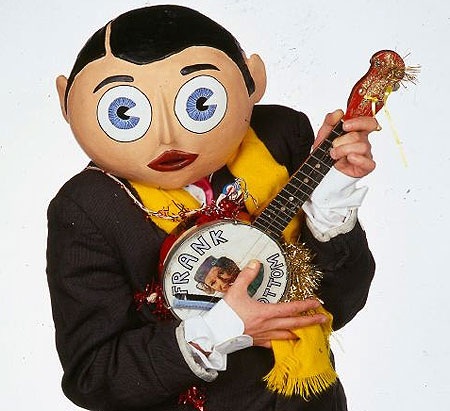
Frank Sidebottom was a major part of the sad story of Chris Sievey, someone whose life was cut short in its 54th year by cancer, having wasted most of it on trying to become famous and unable to accept that perhaps his real talent was more in the background of entertainment than the front.
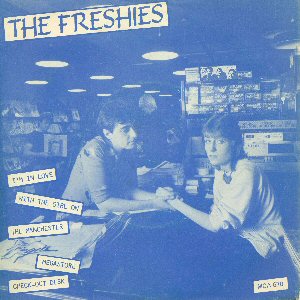
In the 1970s to 80s, his band Chris Sievey And The Freshies tried everything to break into the hit parade, from a sit-in at the Beatles’ Apple Corps record company to releasing a song in 1981 called ‘I’m In Love With The Girl On The Manchester Megastore Checkout Desk’ to try and make the Guinness Book Of Records for the longest name of a song that had charted (which by that year was a stunt every third rate band had tried ever since the Buzzcocks hit ‘Ever Fallen In Love (With Someone You Shouldn’t Have Fallen In Love With?)’ and the book’s editor Norris McWhirter refused to recognise as any sort of achievement anyway). Five flop albums and sixteen flop singles later, they gave up.
One member they turned down was a kid called Johnny Marr as Chris thought he was too young. Disappointed, he formed his own band instead with another local kid called Steven Morrissey called The Smiths who by 1984 were on the road to major success. Two former Freshies Martin Jackson and Billy Duffy went on in turn to become world famous with Swing Out Sister and The Cult.
Chris now tried to cash in on the new computer games boom as a new gimmick. First he put the sound code for a computer game he wrote, ‘The Flying Train’, on the back of his solo single ‘Camouflage’. It’s been hailed since as the first ‘multimedia’ single, but in truth Pete Shelley had already done it earlier in the year for his XL1 album (featuring the hit single ‘Telephone Operator’). Pete Shelley had been the lead singer/songwriter of the Buzzcocks. Beginning to see a pattern here?

Chris now decided to have a crack at making money in the blossoming computer games industry with The Biz for the Sinclair Spectrum in 1984, about trying to becoming a pop star. Nothing like writing from experience.
Appropriately, it was released by Virgin Games during their brief flurry into the new and rapidly growing home computer software market.
But once again Chris met failure. The game was too similar to the previous year’s It’s Only Rock’n’Roll by K-Tel, except harder. Virgin spent a fortune in adverts, but they were releasing games like The Biz written in slow BASIC with blocky visual graphics whilst the tiny companies that dominated the computer games industry – Bug-Byte, Imagine, Ocean and of course Ultimate Play The Game – had been releasing games in faster machine code with far slicker presentation for well over a year.
Trying to promote the game as written by a ‘genuine pop star’ when he was nothing of the sort (the Freshies highest UK chart placing being No.54 in the UK) wasn’t the brightest PR stunt in the world either.
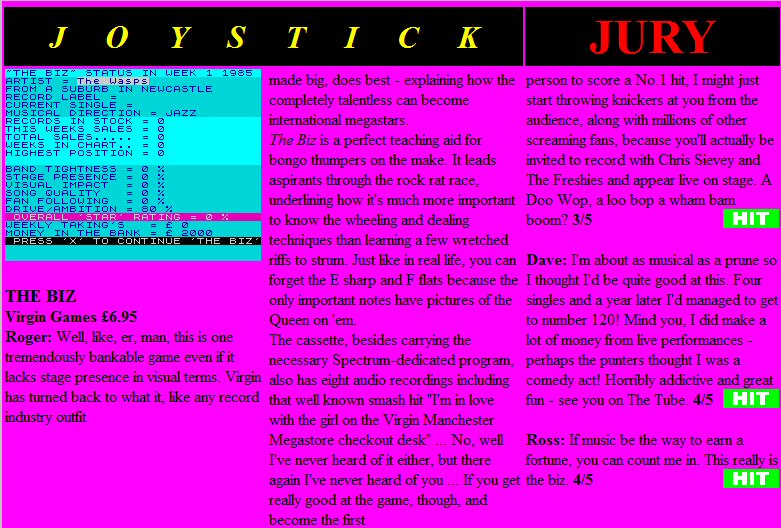
Despite a very positive review by Your Sinclair (who could effectively make or break sales of games), the game sold poorly.
You can try out the game for yourself at the following website:
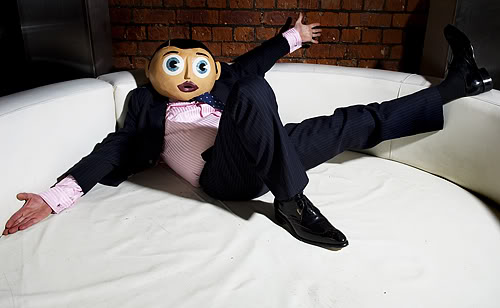
Included on the tape of the game (games being released on cassettes in those days) was some songs from the Freshies days and Chris being ‘interviewed’ about the game by someone with a Punch and Judy like voice called Frank Sidebottom (in reality this was also Chris).
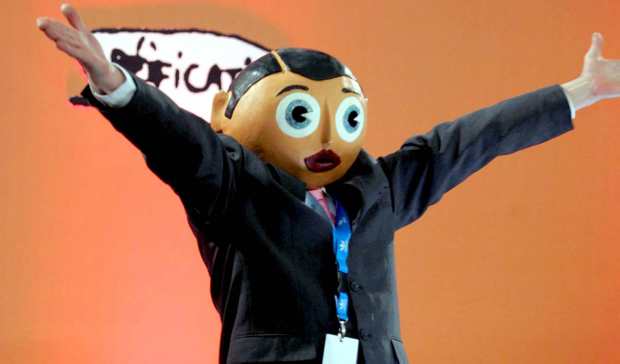
Frank Sidebottom was originally a Freshies PR stunt who was supposed to be their biggest fan from Timperley (a village all but swallowed up by the neighbouring town of Altrincham in Cheshire). Frank was also used in PR gimmicks for The Biz, the most distinctive part of him other than his nasal voice was his giant paper-mache head.
Having failed as a computer games creator, Sievey decided to reinvent himself around Frank Sidebottom as a musical comedy act similar to that of George Formby’s naughty but naïve northern English mummy’s boy, songs often ending with a reprise along the lines of ‘You know they are, they really are’ and ‘Thank you very much!’
The appeal of Frank’s act was less from his songs than from the running joke of Frank’s endless optimism that superstardom awaited him – all planned in child like fashion from his garden shed whilst he lived with his mum – despite minimal talent. That while wearing a giant paper mache head with bulbous eyes like he was some Disneyworld character on crack.
(In reality Chris had a wife and kids who eventually tired of his hopeless quest for fame and fortune and separated)
Occasionally he was accompanied by his ventriloquist dummy, Little Frank (which looked like him) and even rarer some other puppets (which also looked like him).
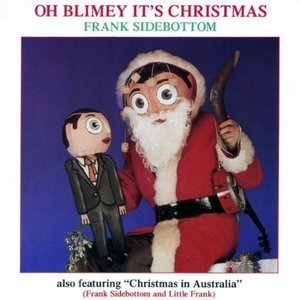
This led to a major recording contract with EMI (using their Regal Zonophone imprint) who saw him as a family orientated novelty act – equalling Frank’s own naivety and showing they remained badly out of touch with what audiences now wanted even after getting their fingers so badly burned in the punk era.
Although this time Sievey dented the lower end of the UK charts twice (one better than the Freshies) and made a number of TV performances, chart success eluded him again and he was dropped. Records released on various independent labels afterwards fared as badly.
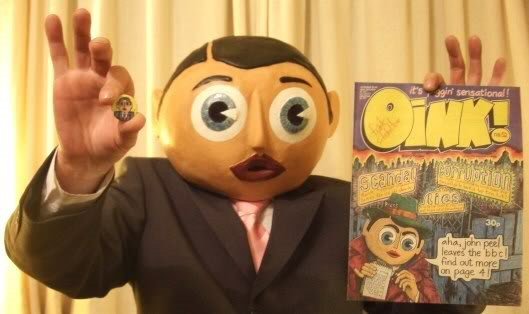
He even had a strip in the ‘alternative’ children’s comic Oink! (another flop that has undergone a great deal of historical revisionism – or ‘reappraisal’ as journalists with noses like Pinocchio like to call it) that some blamed was partly responsible for its demise.
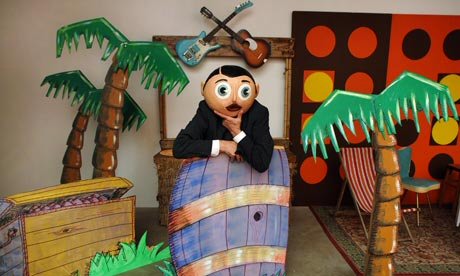
The trouble with Frank was that his act was loved by either very young children (which wasn’t what he was aiming at), by university students for the same reason they would pretend to like Monty Python, alternative comedians or anything else that mainstream society didn’t ‘get’, or by inverted culture snobs that romanticised Sievey’s act as being some sort of parody of popular culture to which he’d never ‘sold out’ and had remained true to the ‘punk ethos’.
The reality was Sievey had desperately tried to ‘sell out’ for two decades, the trouble was he couldn’t ‘sell’, forever trying to jump on bandwagons long after they’d reached their terminus, whether it was the whole DIY nature of Frank’s act that was old hat by the post-punk mid-80s or writing obsolete BASIC computer games fit only for magazine cover tapes.
His act also sharply divided opinion. Those who didn’t like Frank Sidebottom tended to despise him with a vengeance, finding him trite and not in the least funny, little more than childish ‘student’ humour and a liability to have on your show in any capacity if you didn’t want to lose viewers in droves. Some parents also complained his paper mache head with giant eyes scared their children. One radio DJ who played one of Frank’s many covers, ‘Wild Thing (In Timperley)’ was even reputedly called to the station’s manager whilst still on the air and threatened with the sack if he ever played another Frank Sidebottom record ever again. There was far more Frankophobia than Frankophilia.
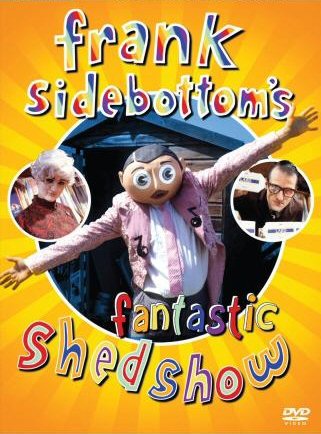
His first network TV show, 1991 Frank’s Fantastic Shed Show was dropped as a monumental ratings disaster (even considering its late night placement). By the 1990s even the pub act bookings were drying up, and he was very much a spent farce, apart from sporadic appearences in various children’s TV shows and twilight programmes on national TV (where most viewers, out of their minds on whatever uppers, downers and inside-outers they’re on, probably thought they were watching Jools Holland. As both had painted hair, sharp suits, silly nasal voices, no neck, oversized heads and eyes, it would be an easily made mistake).
Equally unfortunately for Frank, two side acts from his cancelled show proved to be more successful than his own in their own right – largely parodying his own act and moribund career. Caroline Ahern’s Mrs Merton (an aged twee suburban housewife and aspiring talk-show host) and Graham Fellows’ John Shuttleworth (an aging pub act musician who constantly namedrops others he claims he helped find fame in a pathetic attempt to get some reflected glory). both enjoyed fleeting fame in the 1990s. Both enjoyed brief solo success (particularly Aherne) on TV before vanishing by the turn of the century.
(Fellows was like Sievey also someone that had repeatedly failed to make it in showbiz – apart from a surprise punk hit with ‘Jilted John’ in 1978)
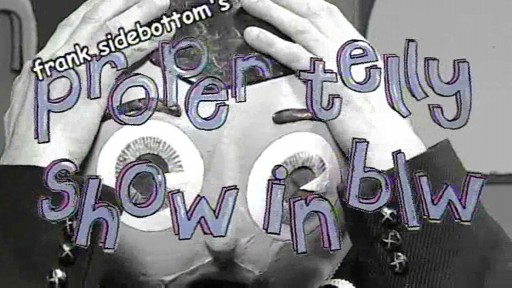
By 2005, enjoying a cultural renaissance now the children of the 1980s were now the university students of the 21st century (and the university students of the 1980s were now parents), Frank briefly got a regular local TV show, Frank Sidebottom’s Proper Telly Show In B/W (it was in fact in colour) in north west England. He also made plans to start recording music again.
He’d by this time enjoyed far more success off stage as part of the stop-animation company Hot Animation, making digital graphic sequences and writing award winning episodes for the children’s TV show Pingu and Bob The Builder.
Yet given another quarter chance he couldn’t resist donning the false head again (now fibreglass instead of paper-mache). Maybe he was fuelled to carry on (convinced one day he would make it big against all the evidence) from overdosing on the bitterest showbiz pill of all – many of those that had worked with him on his various pipe dreams had gone on to become major stars without him – just like Fellow’s John Shuttleworth character.
Five years later, and he was diagnosed with cancer as the years of playing grotty smoke filled pubs and clubs while being a little too fond of drinking before going on stage caught up with him (one advantage of Frank Sidebottom’s head was it made it impossible for audiences or promoters to see if he really was the worse for wear or whether it was all part of the act, not least of all because he refused to ever ‘break character’ once the head was on).
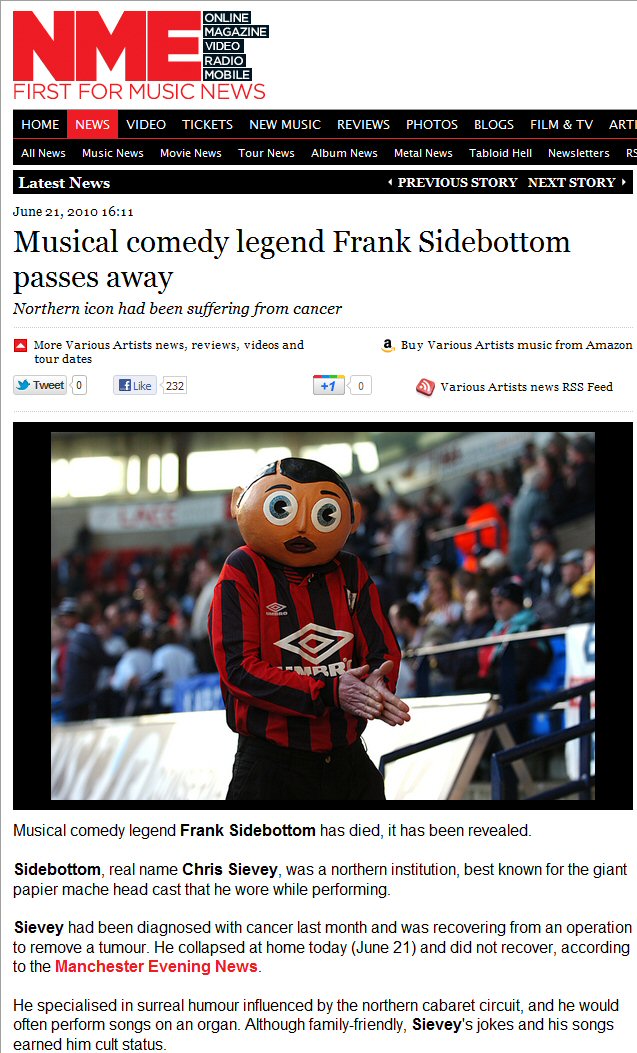
Sidebottom had taken part in an NME charity record, but in truth they routinely ignored his records.
Despite a successful operation, a month later he collapsed alone at his home in Hale and by the time he was found by his girlfriend it was too late, dying in hospital hours later, leaving an ex-wife, two grown-up children and an 18 year old son behind.
The bombshell of his death was swiftly followed by another – he’d died virtually penniless. Despite the sporadic TV appearences, records and the recent work for Hot Animation, he was facing a pauper’s funeral.
In truth, it was no surprise. Many of Frank Sidebottom’s records included bad parodies of famous songs such as the Sex Pistols ‘Anarchy In The UK’, The Smiths ‘Panic’ and Queen’s ‘Bohemian Rhapsody’. Sievey did this probably out of the hope fans of the artists in question (or those that hated them) would buy it, or at least give him some publicity. All it really meant was a large chunk of whatever money was earned from their meagre sales went back to the songwriters in question.
It also highlighted the bitter reality of life for those at the bottom end of the entertainments world. Even on TV, the pay is derisory (if at all), especially if it is an act desperate for any exposure (in the misguided belief it represents a ‘long-term investment) and therefore more easily exploited by promoters, producers, record company executives and finally the act’s own agents.
What little money Chris Sievey ever made out of Frank Sidebottom, it largely went into everyone else’s pocket. Post-mortem claims were made of him enjoying spending more than he earned too much, but this bore little reality to his frugal lifestyle.
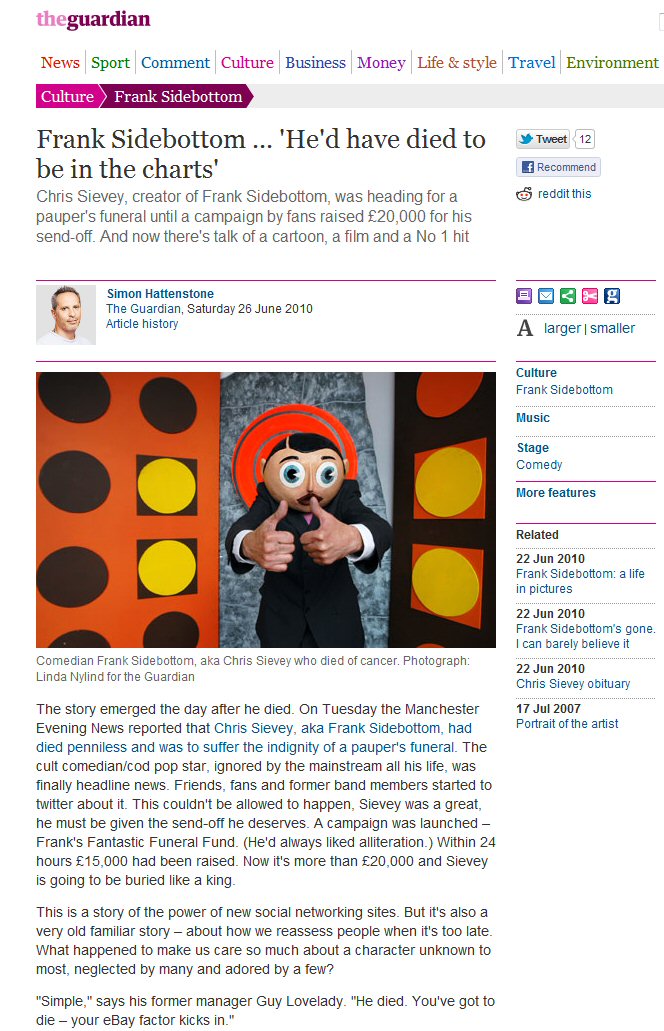
Death - the great showbiz career move. Pass the sick bucket. No film, cartoon or No.1 happened, btw.
What followed left a bitter taste in the mouth. A campaign to spare him from a pauper’s funeral raised over £20 000 in a month – far more than he ever made out of any of his various showbiz ventures. His records and DVDs of his show were reissued with impromptu haste to capitalise on the sentimentalist ‘reassessment’ of his career where everybody loves you when you’re dead – including demands for a statue in his honour in Timperley.
Much was made by broadsheet newspaper columnists and ignorant ‘alternative’ journalists that Frank Sidebottom had been ‘the Bard of Timperley’ who ‘put Timperley on the map’. But it never needed Frank Sidebottom for ‘fame’. Known worldwide as the birthplace of Vimto, this association with that most antiquated of soft drinks (with its ties to the equally dated ‘tee-total’ Temperance movement) had made it a standing joke for local comedians for years indulging in cosmopolitan snobbery laughing at the yokels in the sticks.
What put Frank Sidebottom even more into context as far as his Timperley ‘adoption’ was concerned was that whilst he was still playing dive bars and loss-making council ‘art centres’, doing late night TV shows and making records that sold so few he could have hand delivered them, the Stone Roses (half of whom came from Timperley) were making platinum records selling worldwide.
Whilst he was given some local applause for his backing of the local Timperley Big Shorts football team, the truth was Frank Sidebottom divided residents there as much as elsewhere in the country, not least of all because – contrary to the myth – Sievey was never in his lifetime a resident.
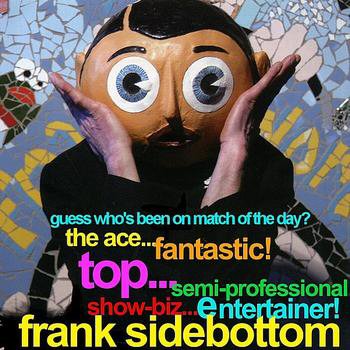
Flushed with the ‘success’ of the funeral fund, what fans Frank had (and his former manager) started another campaign to get Frank into the charts ‘for the first time’ – ignoring the fact 25 years earlier his cover of ‘Anarchy In The UK’ (as part of the ‘Frank’s Firm Favourites’ EP) and ‘Oh Blimey It’s Christmas had charted at 97 (31st August 1985) and 87 (28th December 1985) respectively. But since the proceeds would be going to charity, what was a little historical revisionism?
The instrumental march ‘Guess Who’s Been On Match Of The Day?’ duly charted on 17th July 2010 at No 66 for one week – failing to even beat Sievey’s 1981 best.
With Sidebottom like stoicism in the face of reality, another campaign was promptly launched to get ‘Three Shirts On My Line’ to No.1. before the end of the 2010 World Cup Finals (a parody of the Lightning Seeds famous ‘Three Lions On A Shirt’ England World Cup song a decade earlier) , again with all proceeds to charity. With little surprise it failed to chart, as did another old flop single ‘Christmas Is Really Fantastic’ with another campaign to get it to be the UK Christmas No.1.
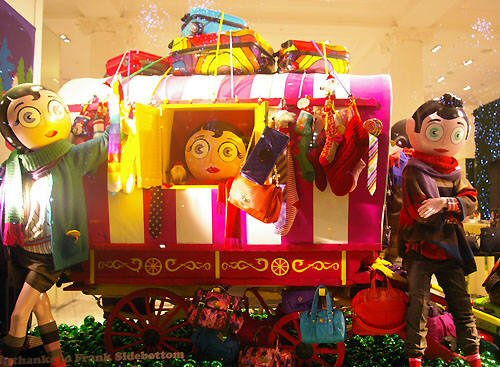
Elsewhere Frank’s ‘legacy’ was tarnished as Selfridges suffered a media led shakedown that November over using window display dummies in London that looked like Frank, although many argued Sievey had no trademark on a visual style he’d copied from Max Fleischer, creator of Betty Boop, same as Selfridges’ designer Erin Thompson had done.
Anxious to avoid bad publicity before Christmas, the store offered to ‘credit’ him in the store window along with a £10 000 ‘donation’ to the executors of his estate – those that month’s before were happy enough to see him have a pauper’s funeral until his fans intervened. Howls of disgust and accusations of cashing in against both Selfridges and those with a financial interest in Frank’s estate duly followed, and with that the post-Sidebottom cultural ‘reappraisal’ duly came to an undignified end.
With the dust now truly settled on Frank Sidebottom (and Chris Sievey), perhaps now is the time to give him his real due as simply a slightly endearing Great British eccentric who dabbled in many forms of entertainment and somehow managed to achieve if not fifteen minutes of fame, at least a good five minutes in total.
Moreover, he made people happy, not merely with his music, stage act and TV performances, but with The Biz being rediscovered by a new generation via Retro gaming websites. Maybe not millions, maybe only a few thousand, but how many of us will ever be able to say as much?
In that sense he was, ultimately, a success.
You know he was, he really was.
‘Thank you very much!’


 AA42
AA42 AA6x7
AA6x7 The Mare's Nest
 6s & 7s
 Skeletal Screams Blogspot
