Getting To The Root Of The Problem: Playing The Vagabond In ‘Root’
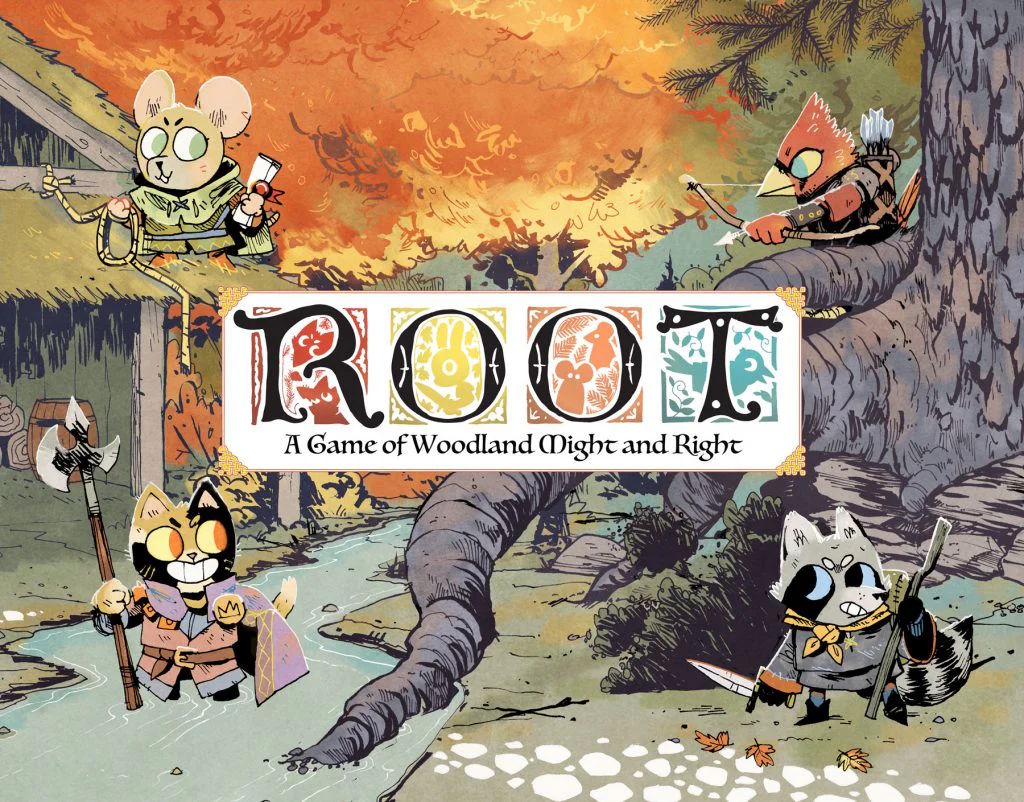
At some stage of wandering around niche shops or the dread scrolls of doom at Christmas and birthday times searching for inspiration, you may have come across this strange little board game.
‘Root’ is a game you can either play as a board game or as an online computer game courtesy of Dire Digital, but however you play it, make sure it is with the full compliment of four players to ensure the maximum enjoyment (the computer version can be played with excellent AI opponents of graded difficulty levels).
 The game starts with four factions – one of which you will choose to play. The only thing they have in common is seeking to acquire 30 Victory Points (VPs) and with it control of a woodland of foxes, rabbits and mice each controlling at least three woodland clearings – or whatever other game board players choose (there are a multitude of expansions).
Now for the plot twist, each player in Root has unique capabilities and a different path to victory. Even the game cards players collect and spend to increase their chances of winning (and thwart their opponents) work differently for each type of player.
Asymmetrical games are nothing new, but seldom has one been so accessible – if infuriating. Unlike many such games, it’s next to impossible for any player to runaway with it, and the race to thirty VPs is often a photo finish in the deciding round.
In the basic game, The Marquise de Cat aims to take control by harvesting wood to build lumbermills, workshops, and ultimately barracks to slowly expand her armed control.
The fascistic Eyrie Dynasty aims to conquor the board by building seven roosts and crushing rivals in accordance with their leader’s decree, but is prone to turmoils with new leaders appointed with their own decree ideas of how to win.
The Woodland Alliance of fox warriors, mice sympathisers and rabbit officers (very Owsla!) are more of an insurgent resistance group quietly building up support in each clearing until strong enough to raise revolts to destroy the forces and properties of the other factions and ultimately send them packing altogether. As such, it’s the favourite faction for performative leftie players.
Finally comes the joker in the pack – the solitary Vagabond – the game’s maverick solely able to move also in the deep woodlands beyond the clearings and connecting paths, acquiring and crafting reusable items to make them the real ruler of the wood by their renown to all creatures – and by smiting the ruin of all other factions if they get too big for their boots.
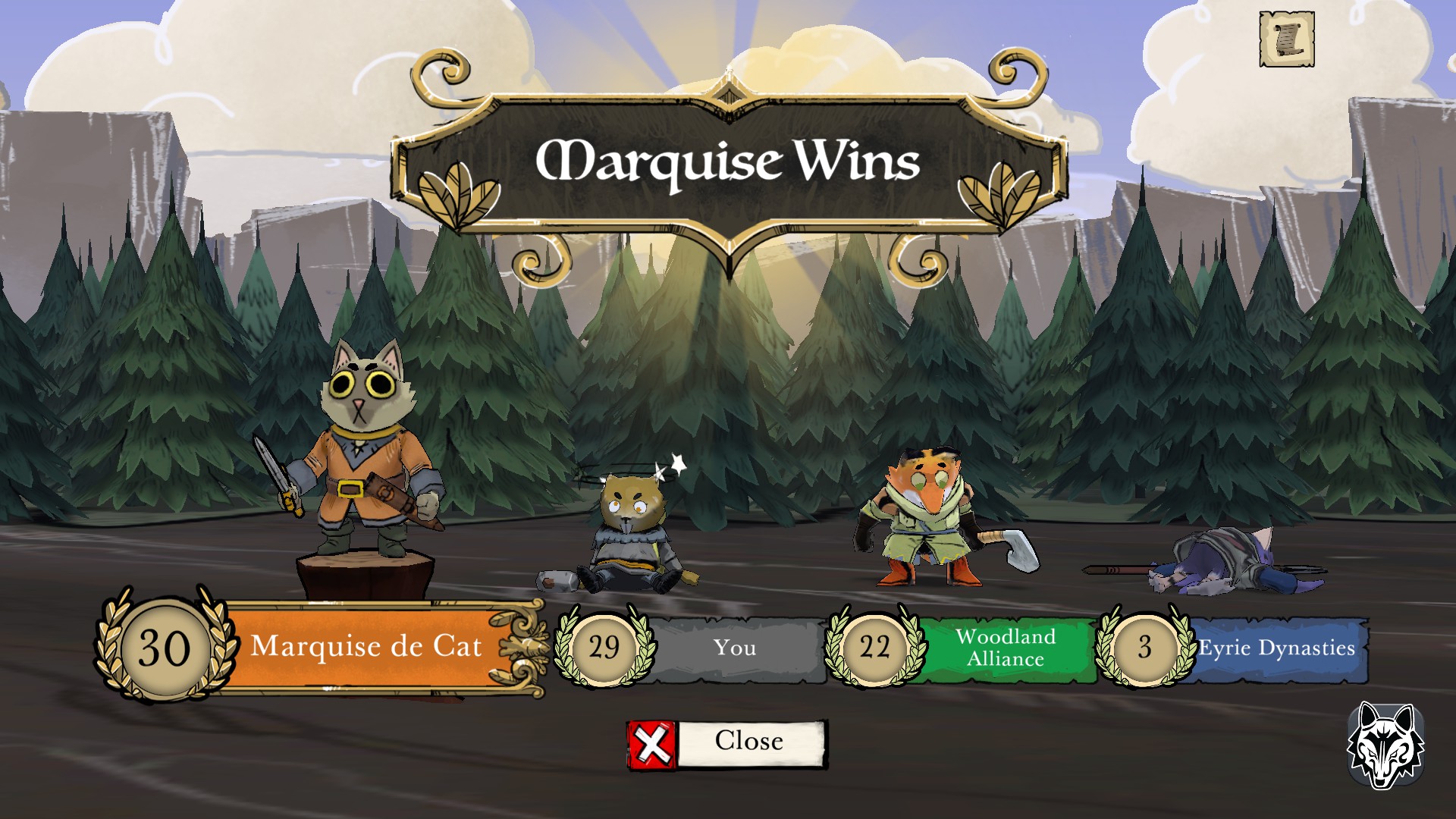
A pathetic 3 VPs: the worst performance to date I have ever saw in playing this game, and even more extraordinary that it befell the Eyrie Dynasties, who along with the Marquise de Cat tend to be the two strongest players – if played right! Yours truly was pipped at the post by the Marquise de Cat who led from the start – by the time I changed to ‘infamy’ tactics, it was too late to stop the inevitable.
Be warned, ‘Root’ can be a bit of a learning curve, albeit a highly satisfying one, and the best way to learn to play is the online edition for Steam, Switch or your choice of app. To begin with, only play solo with AI opponents, try the various factions until you get the feel of how each one operates, and interacts with the others – stick to one for several games, once happy, move to the next one.
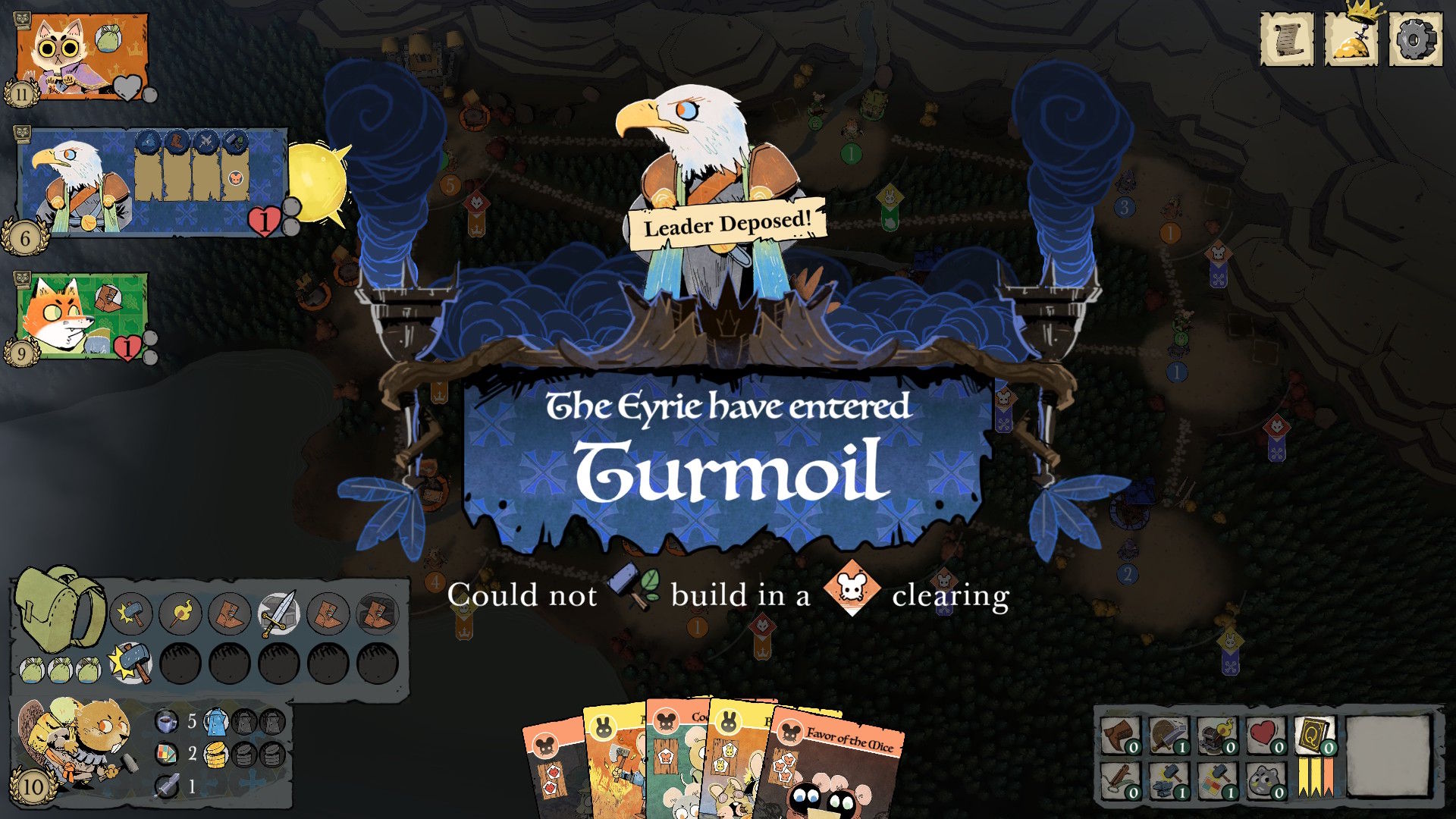
If finding any of them too much – the Eyrie Dynasties may prove particularly irksome with the tendencies for Turmoil – move on. You may find it easier to understand a certain faction while playing the other factions working against it – sounds strange, but it’s true.
For the Woodland Alliance, the destruction of any one of their bases is often fatal: they must discard all supporters matching that base’s suit, and lose half of their officers (rounded up). It will take them at least two turns to get a new base of that suit built again, by which time it is often too late for them to do much to stop someone else winning. Their only realistic hope is that the Vagabond goes on the rampage pinning the other two factions back enough to allow them to catch up – and even then that in itself is more often than not the precursor to a Vagabond win.
Life as a Vagabond.
Of all the factions, the one regarded universally as the most difficult to play is the loner Vagabond, the only player who ever has only one piece on the board.
I disagree with this.
For new players swiftly tiring of the common first choice of the Marquise de Cat (the most ‘logical’ gameplay-wise of the factions), the Vagabond is perhaps the most rewarding of all the factions to play, as the path to victory can only be traversed with patience, concentration, careful planning every move and a solid respect for the equilibrium of their items’ collection – too little of a particular type may at the last moment cost the game.
It also demands the most solid respect for the strengths and paths to victory of the other factions. Root is a delicate balancing act in which power abhors a vacuum – when you sabotage one faction, the other two also benefit every time, and if you are not careful, they may backfire more than you. On the other hand, this in itself may be more to your advantage if that player is due to play next, is weaker, and has an account of their own to settle with the players before you …
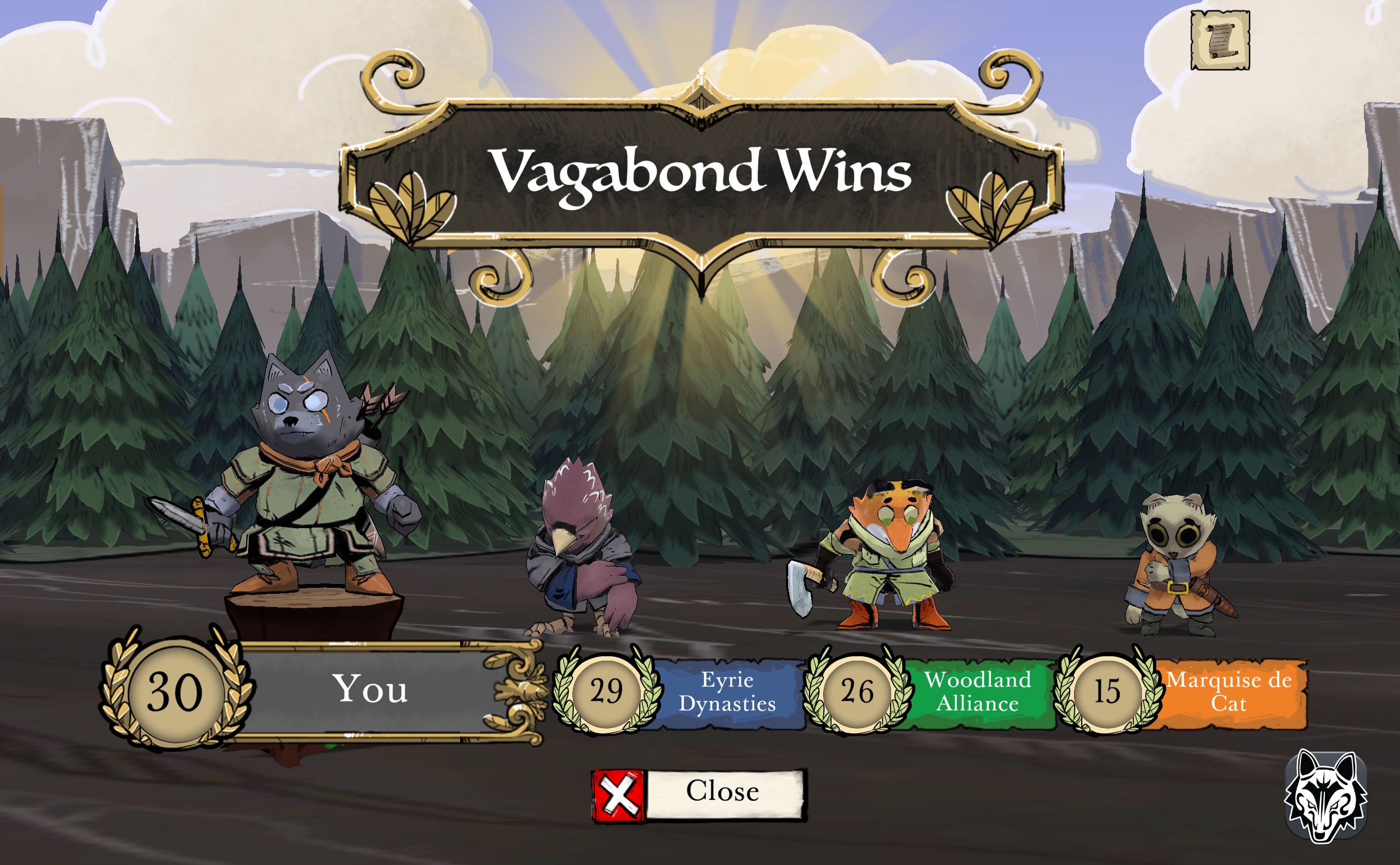
It is however true that winning as the Ranger Vagabond is more difficult than doing so as the Thief or Tinker, and the Tinker is the easiest. But even for the Ranger, the same principle remains, you cannot steamroll to victory the way the Cats and Birds can.
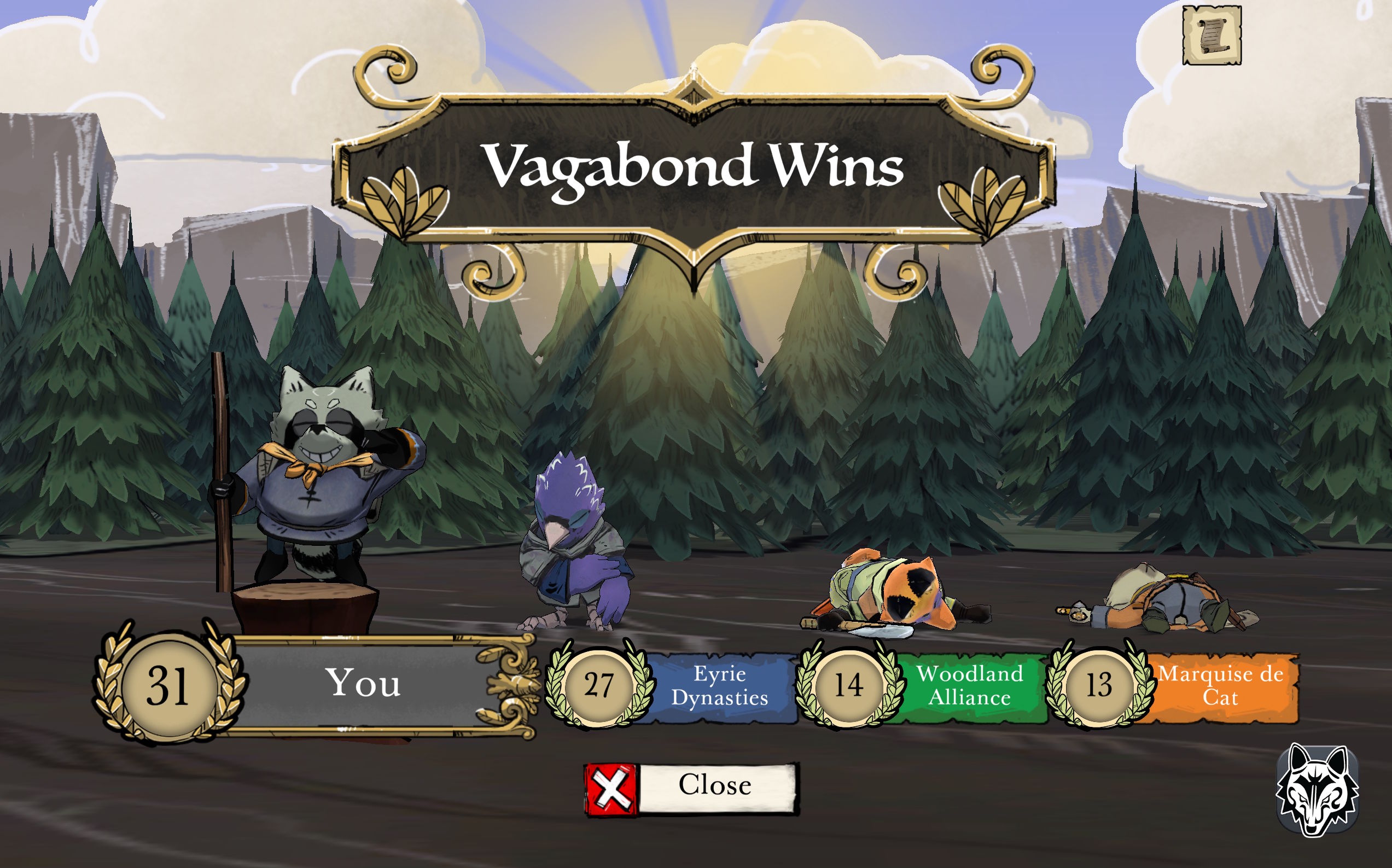
Let me give you an example of life as a successful Vagabond, in this case as the Tinker.
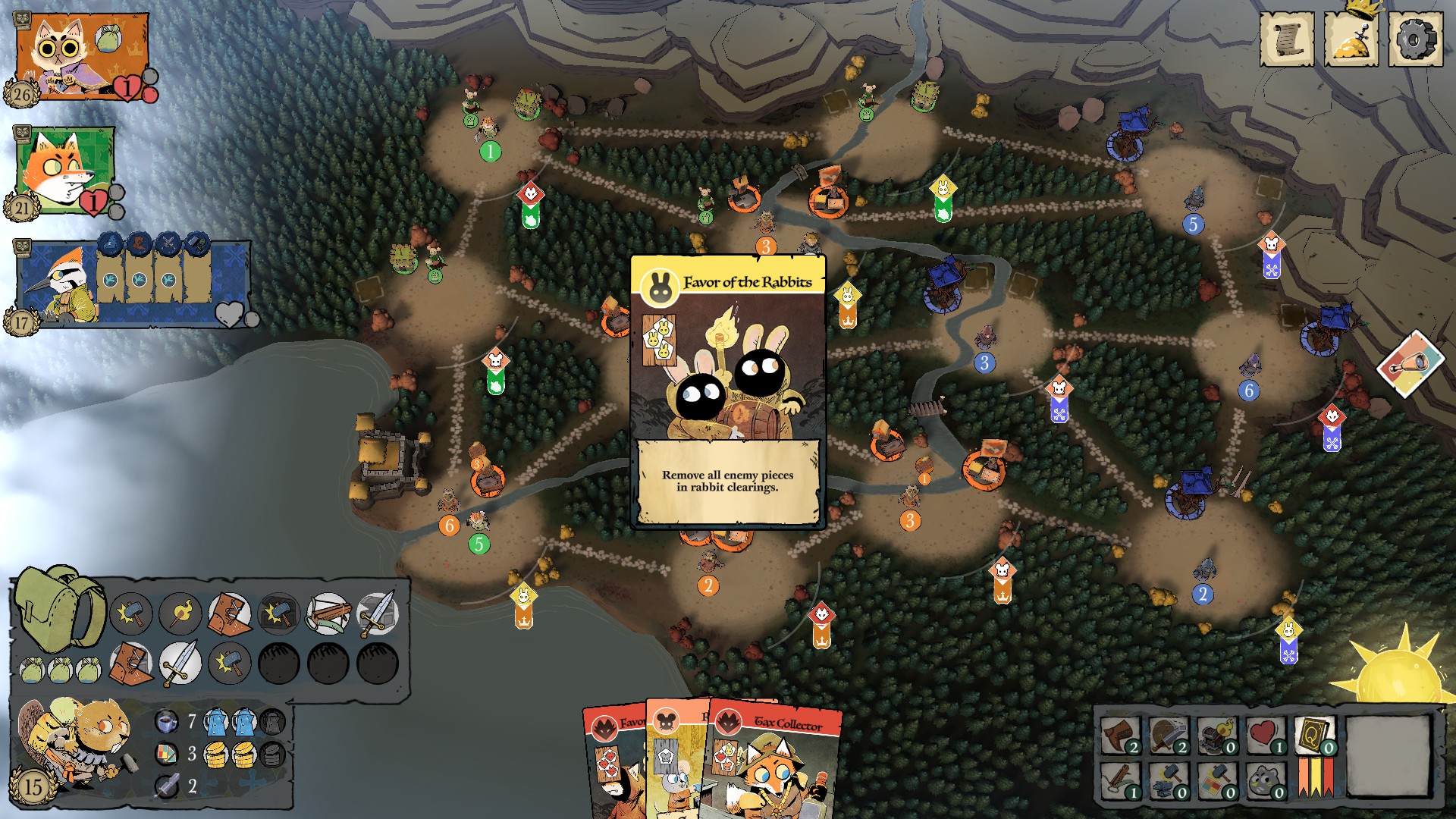
In this game the Marquise de Cat has been running away with it since the start – she was on 20 VPs when the rest of us were all still in single figures, and by this stage was on 26 VPs, in control of five clearings with full buildings on each, had her field hospital reviving every warrior she ever lost as she’d been prudent with cards, and nineteen warriors in the field.
Victory in the next turn for her was all but assured – until someone made the fatal mistake of making an anvil.
Up until that point, my Vagabond had been stuck on two anvils, which meant being able to make everything except the most dreaded card in the game in the hands of a Vagabond – and that’s a Favor.
The three Favor card – one per species – are similar to the Woodland Alliance’s ability to start revolts, except quadrice as deadly. Every single clearing belonging to a particular species – foxes, rabbits or mice – will assassinate all the pieces belonging to all other players and burn any buildings they’ve created, earning the player lots of points if timed just right.
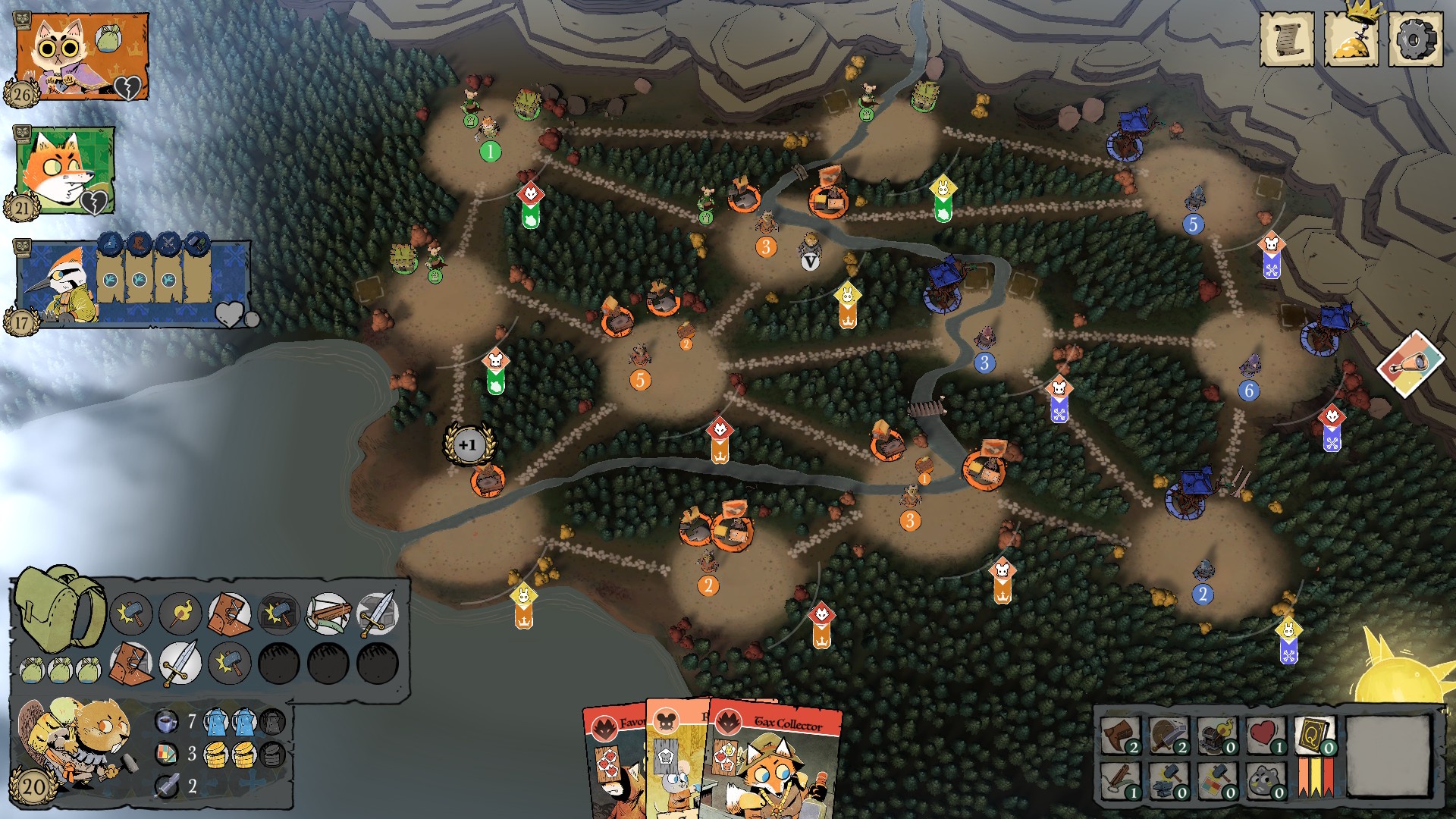
As you can see here, the first victim of the Favor of the Rabbits card being the clearing in the south west corner: taking out the Cat’s Keep, a sawmill and six of her warriors, plus a Woodland Alliance fox warrior – and my VPs total has shot up from 15 to 20.
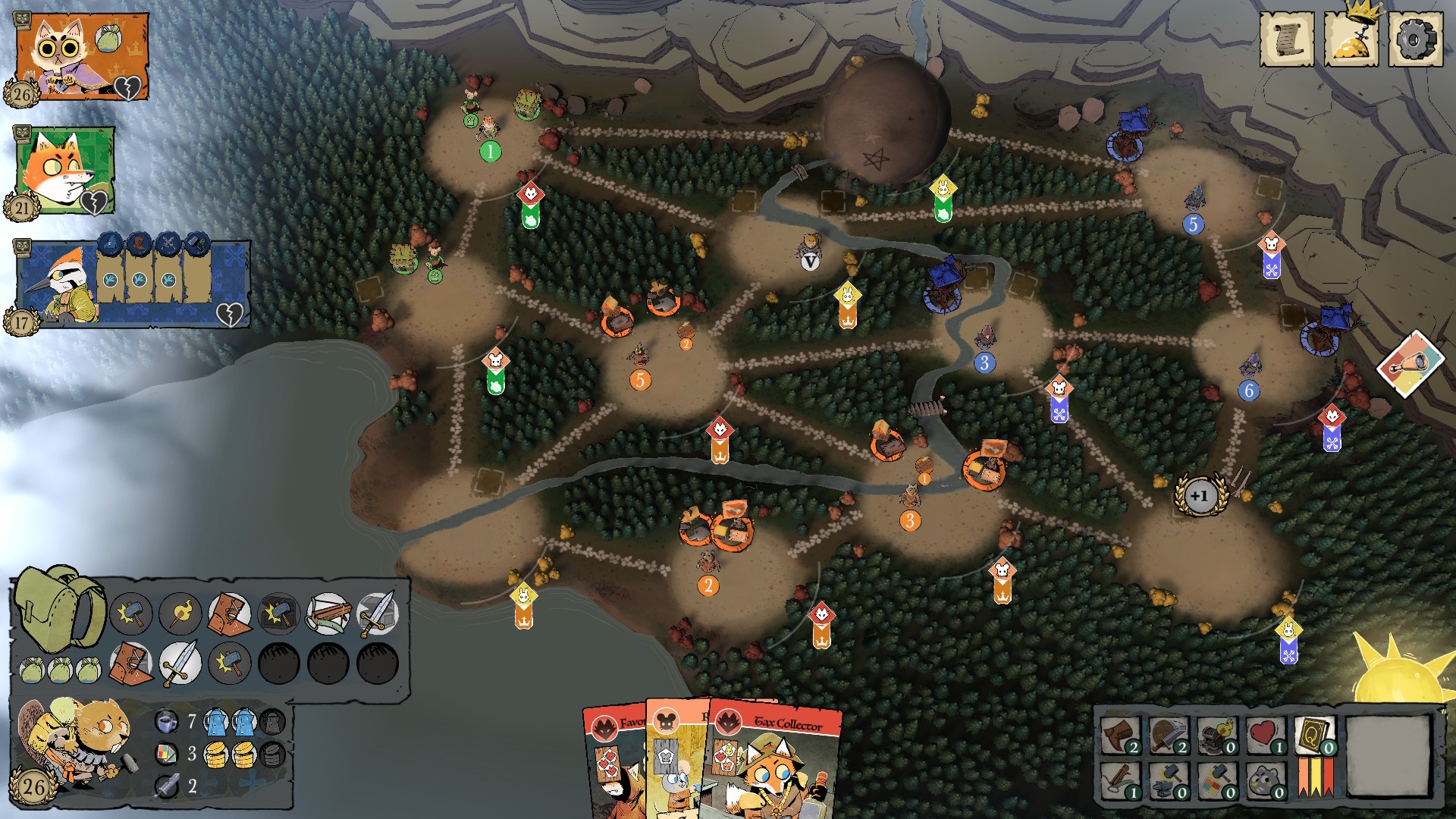
The clearing my Vagabond is in is next – two Cat buildings and three warriors burn, plus an Alliance sympathiser, the south east clearing takes out an Eyrie warrior and a roost, then the north clearing burns for a dead Woodland Alliance sympathiser and their rabbit clearing base.
All of a sudden, my Vagabond is up to 26 VPs, neck and neck with the Marquise de Cat, who of course has lost her base.
But of course, the Cat will get to play again before I get the chance to play that Favor with the Foxes card, and it will quite easy for them to have enough cards and pieces left to make the 30 VPs next more.
Somehow I need to get there first this turn – and as it happens, I can.
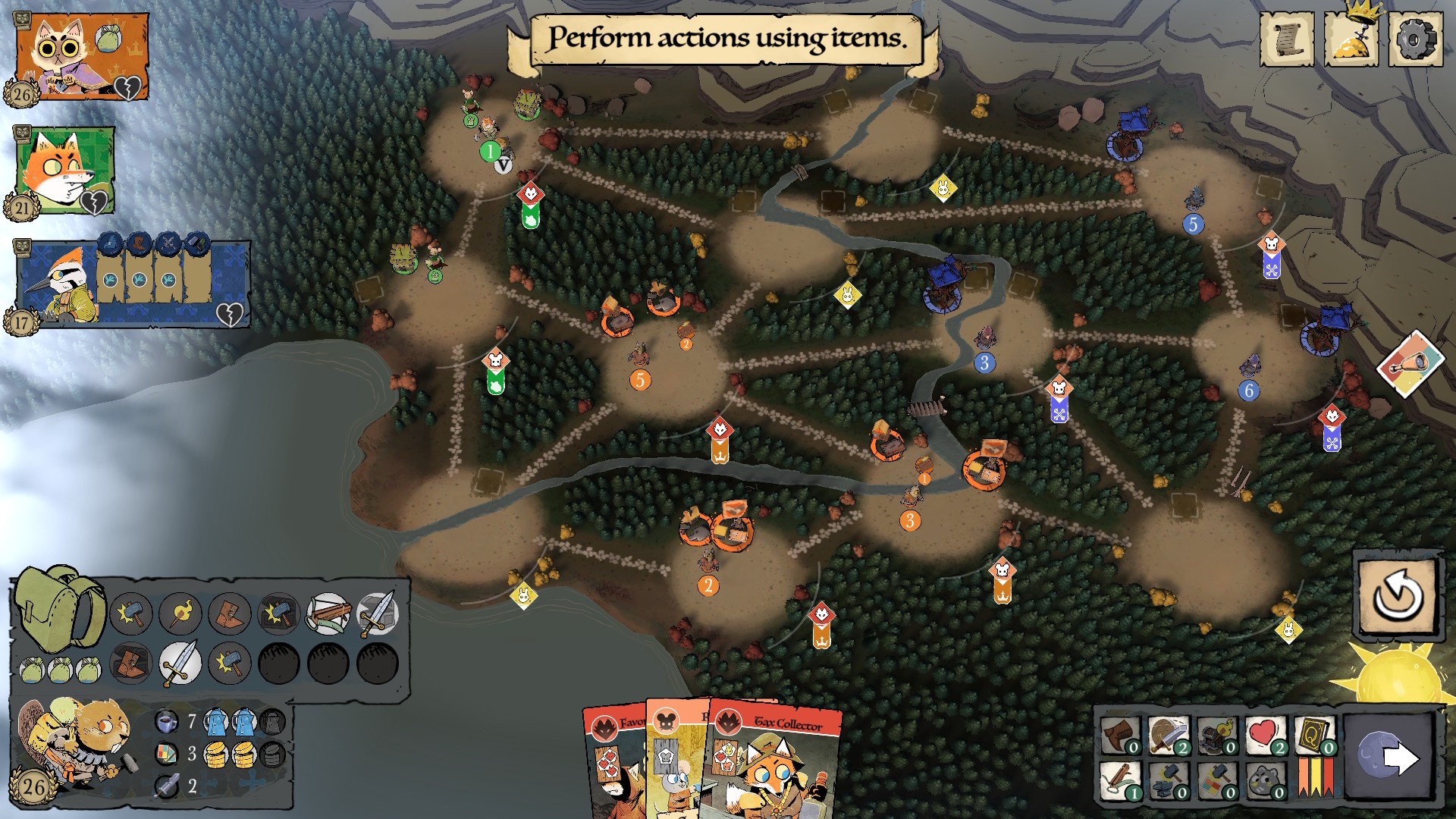
With my two saved travelling boots, I’ve just enough to move into the north west clearing, consisting of one Woodlands Alliance warrior, sympathiser and base. I have two swords for going into battle, but also one crossbow – the sniper weapon no one has any defence from, and means no risk of bad dice rolls in combat resulting in items being broken.
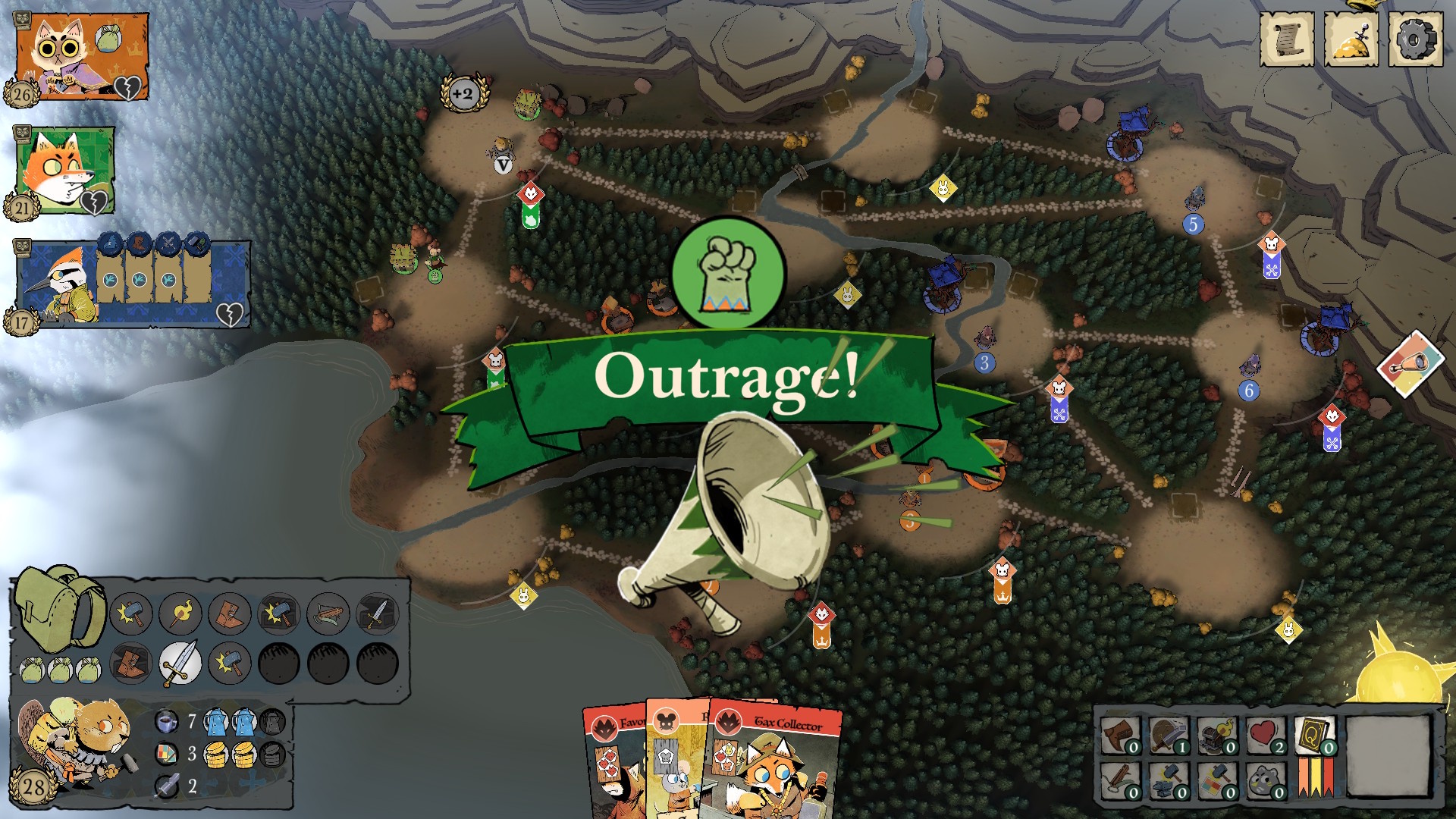
Killing the one warrior and sympathiser generates 2 VPs from the infamy of the deed (you only win VPs from ‘infamy’ after the faction you’ve attacked turns hostile), while destroying their defenceless base …
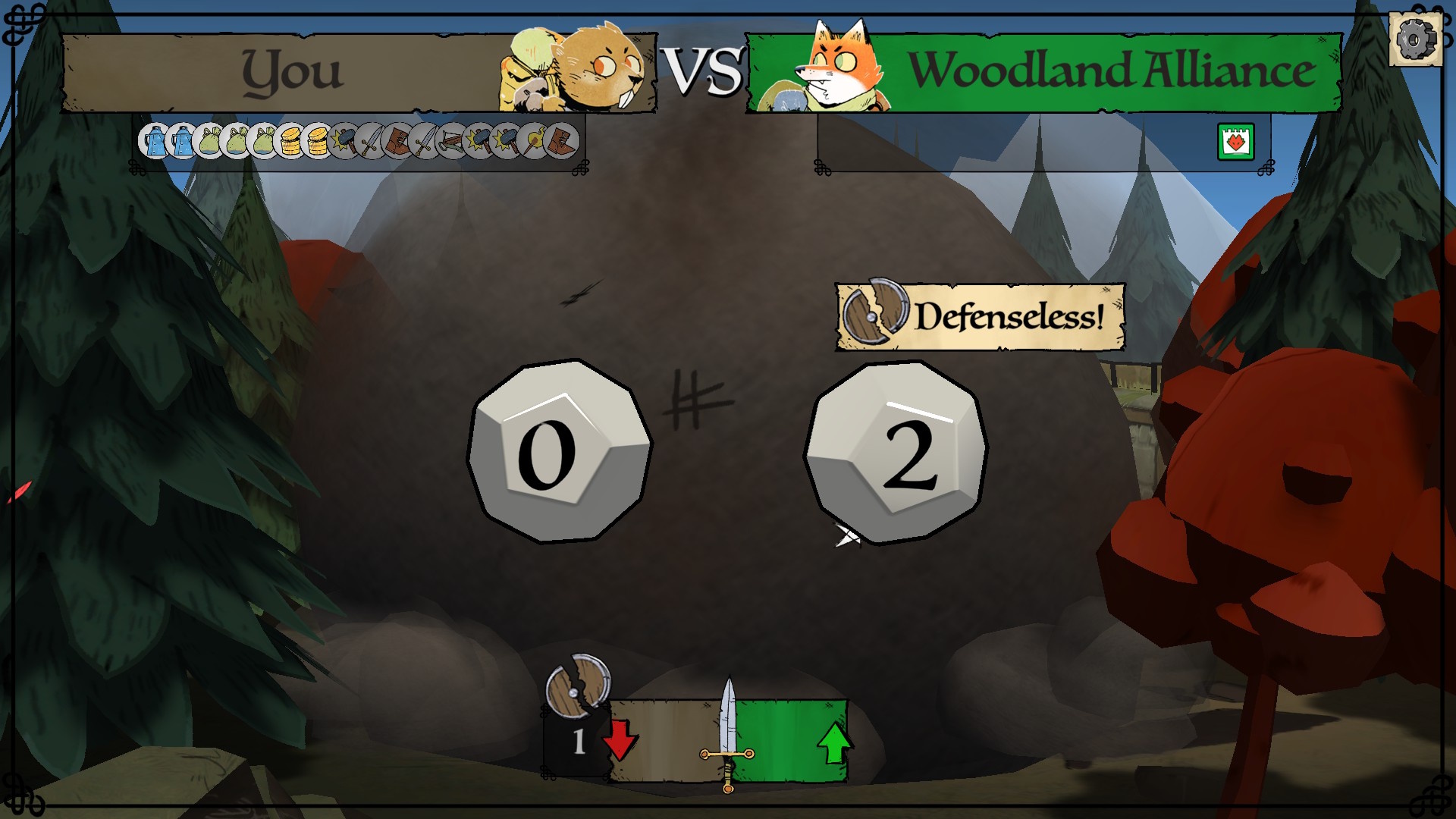
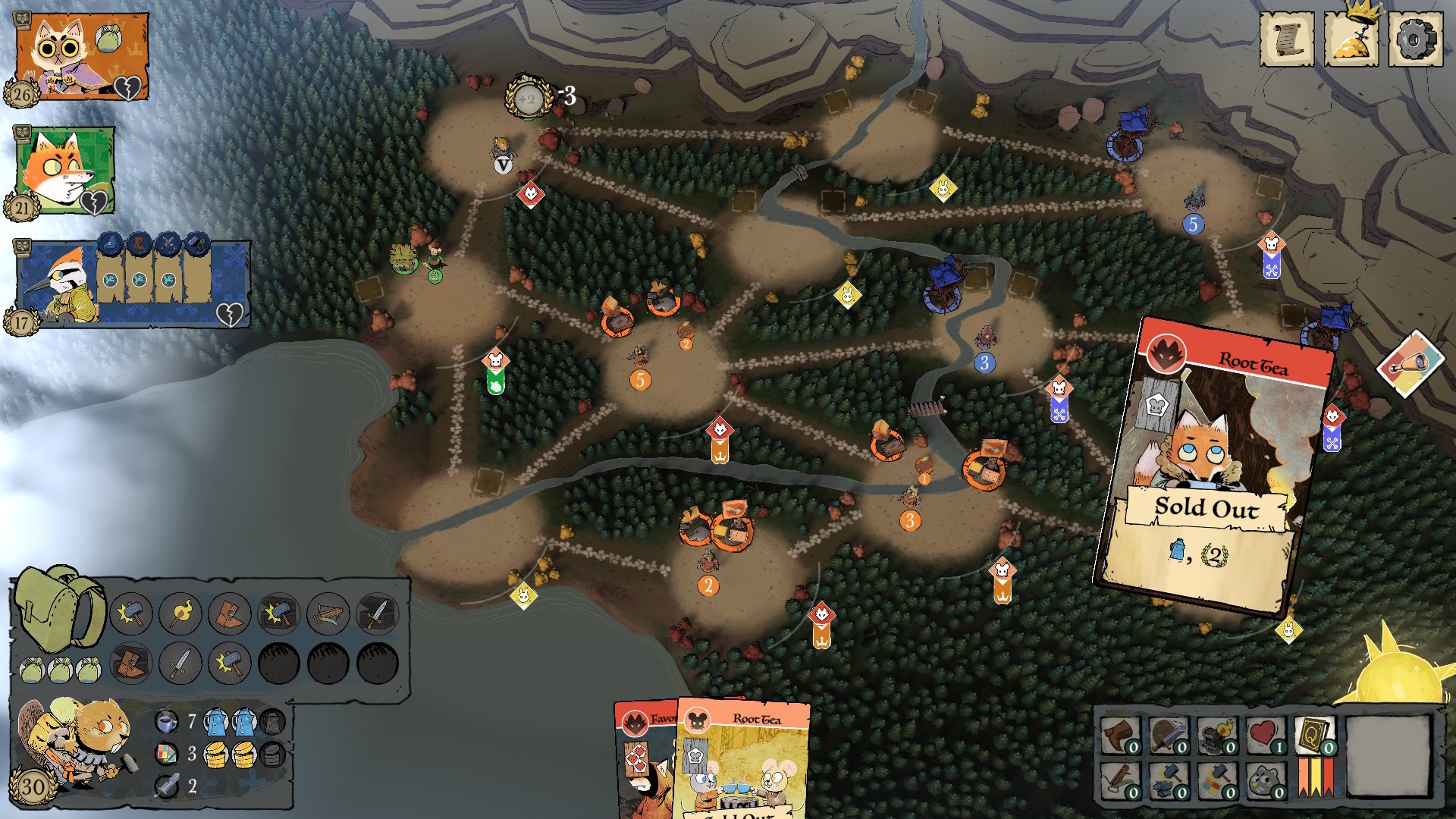
… takes me to the magic total of thirty VPs and victory.
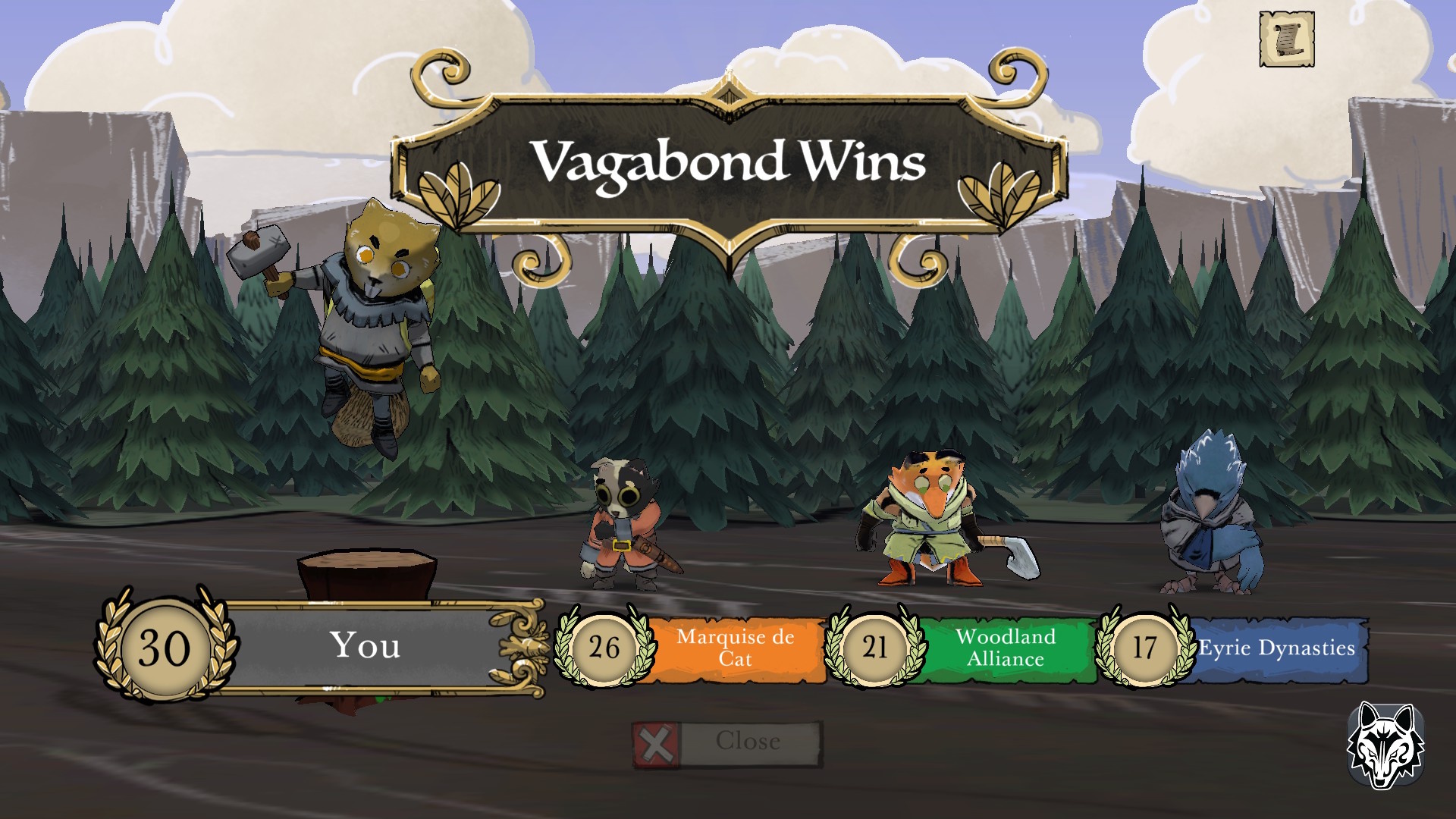
Victory from doubling your VP tally in one turn, the fruits of the labours of the prudent building up unobtrusively to this moment and keeping all the other players sweet for as long as possible.
Unlike other players in the game, the Vagabond has no choice but to play their first Favor card at the last possible moment – the penalty of dropping a Favor bomb is the automatic hostily of all players whose warrior pieces they’ve taken out – and movement into any clearing with hostile faction pieces in place costs double. Remember, movement in or into a forest space (called slipping) is only allowed once per turn, and so the only way you can move from one forest space to another is by starting on a forest space – and for the Vagabond, only being able to move one space in a turn is often disastrous for their chances of victory.
Occasionally you are lucky, the Woodland Alliance has not lost a single warrior from your Favor bomb. But more often than not you can expect the wrath of all three – you will only play this many turns into the game when it will cause the maximum destruction and, ergo, VPs to harvest.
While it is true the Woodland Alliance only starts to build up late in the game and tends to see a ‘strong’ Vagabond player as in its best interest against the two ‘army’ factions of the cats and the birds, their victory still depends on building bases in one of each type of clearing (the starting clearing for any of its new warriors), so it’s almost a given you will destroy Woodland Alliance pieces to trigger hostility.
Once any player is hostile to the singular Vagabond, they make for a very tempting target for an easy battle victory against three Cat, Bird or even Alliance warriors – and a rash Vagabond player can find all their precious equipment smashed up and in no position to reap the maximum benefit from playing a Favor. It cannot be stressed enough, time your moment to play that first Favor card – for once you have, the gloves are off.
Don’t Spare The Tea or Coins.
Before getting to that moment, the object of the Vagabond’s game is to collect as many items of equipment as swiftly as possible, and as prudently. Whilst tempting to rush to make, discover or buy the practical equipment – boots, swords, sacks and crossbows – there’s little point gathering loot without the extra root tea to be able to use it. Each root tea means two extra items can be used per turn, and players are prone to neglect this and coins (the latter meaning two extra cards at the end of each turn) to the detriment of their early development.
You should be looking at a tea level matching your equipment gathered – ideally seven, with three swords, a crossbow (two even better!), and two pairs of boots.
But, most important of all, the first four turns of a Vagabond are simple – going to each of the clearings with ruins and exploring for those free items of equipment. If you are able to buy or trade items from other players during those four, so much the better, but the priority must be collecting the four
Ambush and Defence cards are important.
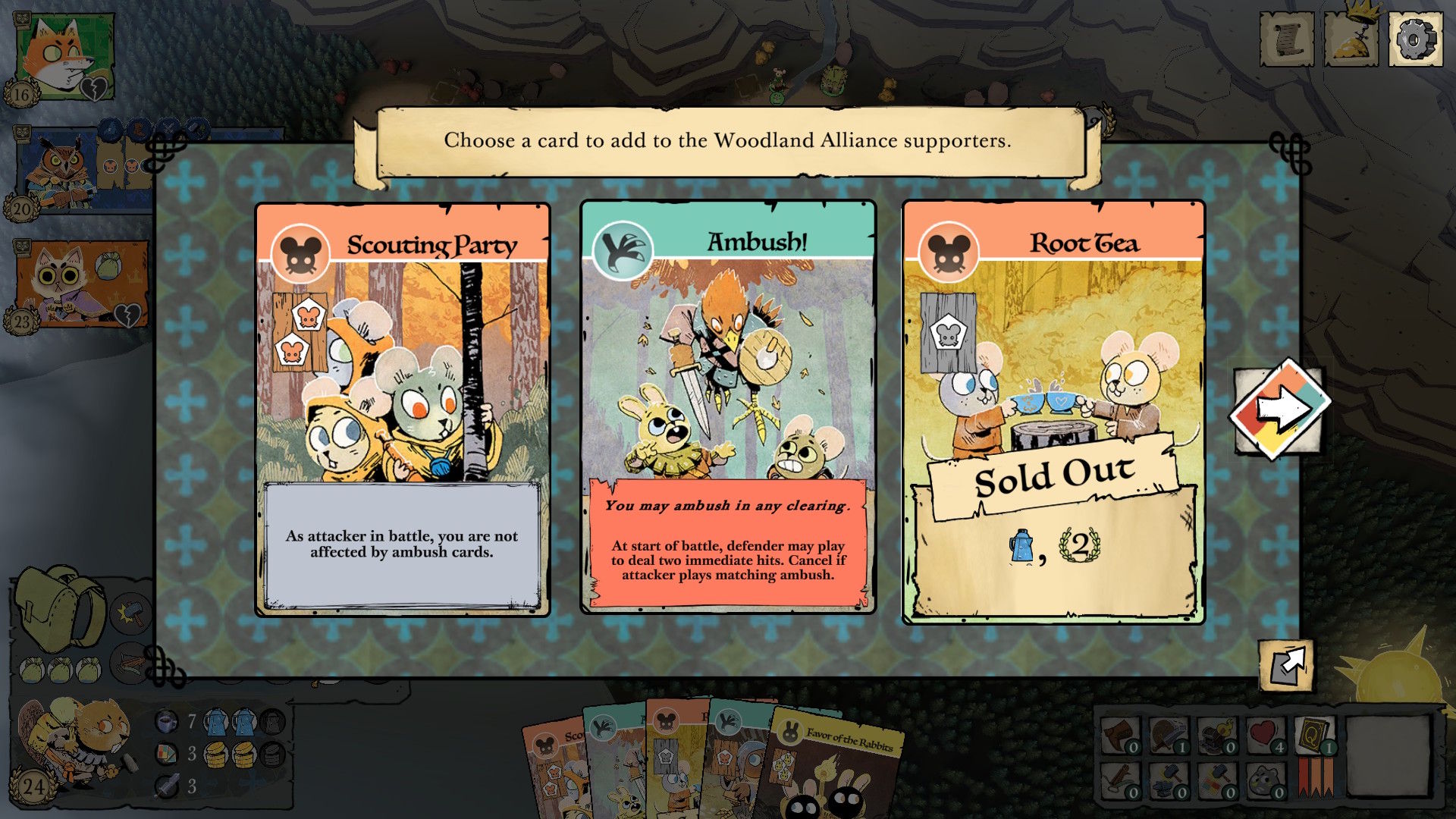
It’s too easy to see the ‘battle’ cards, especially the ones you cannot build, as taking up ‘space’ amongst the precious maximum five you can keep in hand at the end of any turn. But you need at least one, preferably two, in order to have some sort of protection against opposing players deciding to smash you up and with it your items.
It is also a good idea to max out your items as a protection from losing any clearing battles – you can sacrifice them to be broken for repair later when convenient rather than vital pieces. You can always ditch them if you need to make space for more vital items you build later.
Ending turns in clearings.
Where possible, if still on good terms, end your turn in a clearing where the Woodland Alliance has a base, regardless of whether they have any warriors of their own there or not (actually, it is an advantage if they do). They have the least reason to harm you in the early game unless they are completely stupid (the converse is not the case, picking off lone Sympathisers gains you a VP each time)- their focus is on spreading sympathy to as many clearings as fast as possible to generate Outrage which means cards. If a Cat or Bird warrior moves in, they will attack the defenceless Woodland Alliance base for an easy win ahead of attacking you – armed with possible swords or possible ambush or sapper defensive cards. If there’s at least one Woodland Alliance warrior, they are even less likely to attack, due to the way combat is so ludicrously in their favour.
Never, ever end your turn in a clearing with a sympathiser of a species the Woodland Alliance has not yet built any base in – you will make it a highly tempting target for Revolt as three of your items will be broken, and if any Cat or Bird pieces are also there when the Woodland Alliance player’s next turn comes, it’s almost a given.
Once you have fallen out with one or more players, prioritise getting another Favour card of the two remaining species, then swords, then defensive cards to craft or keep. You will become a target as they all know one more Favour played and the game is yours, but if they attack you and you’ve carrying ambush and sapper cards, it can quickly turn into a disaster for them.
Root is a game that will addict you, infuriate you and charm you. The balance between the factions may look uneven, but in practice they are about as near perfect as it is possible to achieve. Try it: just don’t blame me if you find yourself at two in the morning muttering to yourself, ‘getting the hang of this … just one more game …’


 AA42
AA42 AA6x7
AA6x7 The Mare's Nest
 6s & 7s
 Skeletal Screams Blogspot
