Netflix ‘The Sandman’ – A One Way Trip To The Planet Snooze
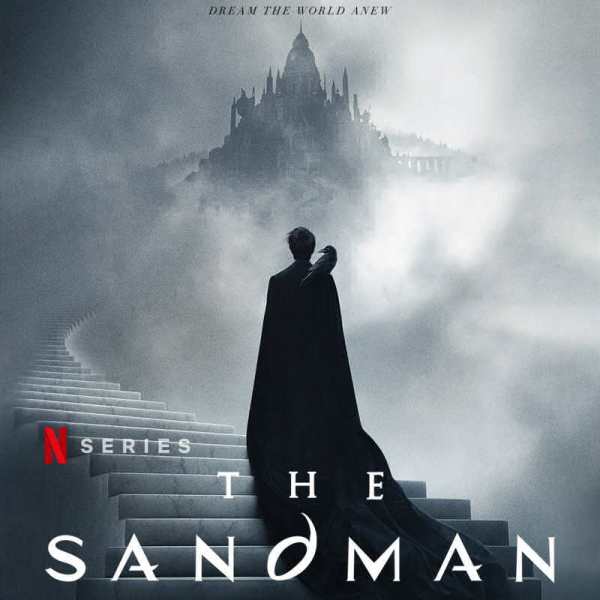
You can put in all the diversity you like, action all the woke bullet points you like, pander to all the screechiest ‘rights’ groups in the zeitgeist you like.
But a badly done series is a badly done series, no matter how many boxes you tick in order to give yourselves some ready made excuses that all your critics are ‘just racist’, ‘just homophobic’, ‘just transphobic’, etc – the cold hard truth is you are fooling no one but yourselves that you cut corners and served up a bloody dog’s breakfast.
I wanted so much for this to be good. Having used part of lockdown to complete reading the whole damn thing from start to finish (some bits are better than others, and it is fair to say it became apparant he’d grown bored with the project long before it was put out of its misery), I was prepared to accept there would be changes, not least of all because of the move of formats, and tweaks to the storyline to offset past regrets at the original writing and the plotholes which naturally come with such an Edda.
But after the first series, the reported leaking of ‘A Dream Of A Thousand Cats’ – the Twilight Zone meets Tales Of The Unexpected style intermission to the main saga (and one of the most celebrated of all the Sandman stories) indicates that for all of Gaiman’s ‘fuck you!’ bluster to his own fanbase, Netflix is panicking it has half-cooked another turkey and trying to keep everyone prepared to give the next series a chance – and you can’t blame them, after the almighty crash in its subscriptions in 2022, Netflix cannot afford all the investment it has purported to make in this show (pity most of it was dime store CGI) to be all for nothing.
What makes the smothering wokeness of the series even worse is the very real racism in the show – you know, the whole ‘blacks can only ever be attractive to and attracted by other blacks’ vibe in ‘A Hope In Hell’ and ‘The Sound Of Her Wings’ … who wrote the TV screenplays for this, Eric Cartman and Louis Farrakhan?
To a graphic novel series whose rich diversity of characters of all creeds, colours, genders, sexualities, etc, etc. came three decades before the social justice warriors began their Taliban style ruination of civilized society’s culture, this has been beyond insulting to watch, ever more so when Gaiman and his sycophants have had the almighty cheek to say those criticising it ‘clearly never read the original Sandman.’
Oh yes we damn well did – and that’s what makes this so unforgivable, to say nothing of Neil Gaiman insulting openly his own fanbase now he’s on Tinsel Town’s payroll and feels he no longer needs it. He should watch what’s happened to his old friend J K Rowling – another shameless plagerist creator who discovered the hard way what happens when you piss on your fanbase once too often.
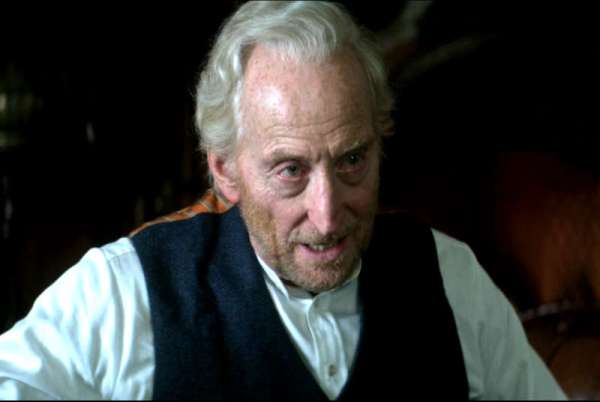
The first two episodes with the brilliant Charles Dance (has that man ever acted a scene badly in his life?) were wonderful, and Tom Kerridge’s slowburn Morpheus the Dream Lord superb as he waited his chance to escape.
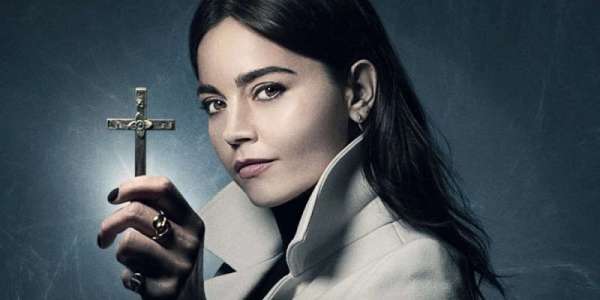
The alarm bells first went off with arch-rogue John Constantine’s character being merged into that of his ancestor Johanna Constantine for what appeared a cheap excuse to have Jenna Coleman do a lesbian scene for fan service. You can almost picture the directors glee – ‘hey, the hot former Dr Who girl! She’ll be up for it, she started her career as a teen lesbo regularly at it hammer and tongs in crap Teawop soap opera Emmerdale!’ – and who cares about the plot problems resultant?
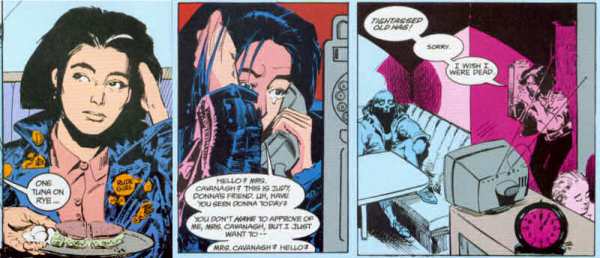
Contrast this with what ought to have been one of the most emotionally draining parts of the series, ‘24 Hours’ (renamed ‘24 and 7′), and fate hammering poor Judy into the ground after her break-up with Donna Cavanagh aka Foxglove after allowing her own fear of losing her to get the better of her temper (and if Donna thought Judy had issues, just wait until she discovers what her mousy little student neighbour Thessaly is like when she’s pissed!).
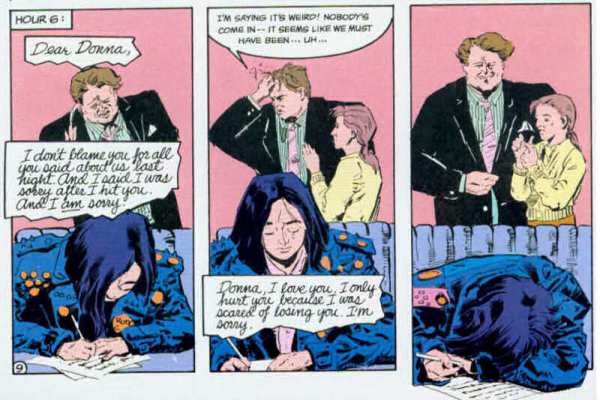
In the graphic novel, it’s heart rending to watch Judy’s biker jacket and short hair tough girl persona crumble as the hopelessness of her situation becomes apparent (she breaks down while trying to write a letter of apology to Donna for hitting her, in doing so clarifying to herself she’s blown it and there’s no coming back from what she’s done) – not least of all because Judy appears to be the only one in the whole diner who isn’t singularly in love with themselves, and left a wreck because of it.
It makes her later murder by John Dee (inducing her to commit suicide in the most horrific fashion of all his victims) all the worse to take in.
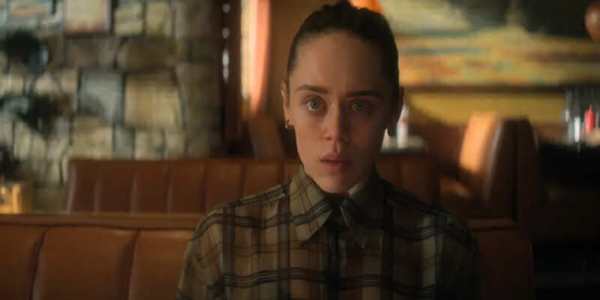
Instead of this, we have a Judy with the emotional range of toilet paper and ‘whatever, bro!’ delivery (played by the daughter of Giles from Buffy The Vampire Slayer and Nescafe Gold Blend – proof acting talent isn’t passed on via genetics …), quickly getting on down with the waitress as catharsis, a brief moment in the comic, but in the TV show … well, you can guess.
If this is Netflix and Gaiman’s idea of inclusivity, it’s clear they have learned zero from the clusterfuck The Chilling Adventures Of Sabrina collapsed into which saw the series abrupt cancellation from crashed viewing figures and messy ending that satisfied no one but the accountants as it self-indulged minor character Lachlan Watson’s real world self-loathing identity crisis in the scripts through ever more absurd plot twists until the show disappeared down the maw of its own absurdities.
The diner episode where Dee (who is nowhere near the sympathetic character portrayed by David ‘Remus Lupin’ Thewlis in the show) toys with, tortures and finally induces suicide in his victims (whilst outside the world plunges into chaos at Dee’s bidding) is a turning point in the Sandman series, letting the reader know how much this is an other world every bit as red in tooth and claw as our own – in fact even more so, and with humour equally as black as pitch.
Yet one of the most famous gallows humour moments of the series which takes place during the Diner grindhouse affair is completely omitted – a blackly comic moment which made what is a heavy going, depressing sequence of events bearable – that of John Dee remotely f**king up ‘Dino’s Kid-Vid Playhouse’.
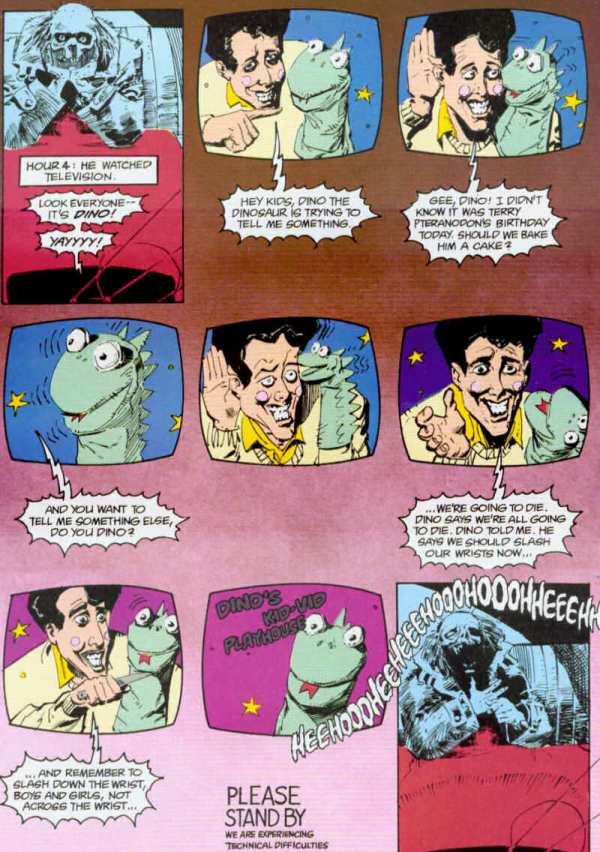
Generations of casual readers have been flung out of comic stores and bookshops screaming with laughter from this one page – for some it started their love affair with The Sandman series and its whole mind-twisting ride.
Yet Netflix left it out, afraid it would fall foul of some ‘sensitivity awareness’ gatekeeping skeets. Leave out the references to suicide in case someone gets ‘triggered’, but keep in the serial killers showing off the trophy eyeballs ripped out of their victims. Go figure.
Another victim of this wokery was the erasure of the Wood of Suicides, one of the most poignent moments in The Sandman. Those who die willingly by their own hand are turned into trees forever in abscission in Hell, never free from their suffering. The Dreamlord remarking once it was merely a grove, but in time has become a forest …
What The Hell Is This … Hell?
Yet long before reaching this rubicon and seeing it was a sewage overflow, the warnings were all too apparant. ‘A Hope In Hell’ – one of the most powerful early parts of The Sandman series, one which set the tone and meter for the entire series in the vastness of its breadth – only for the telly version to promise mountains and delivered molehills.
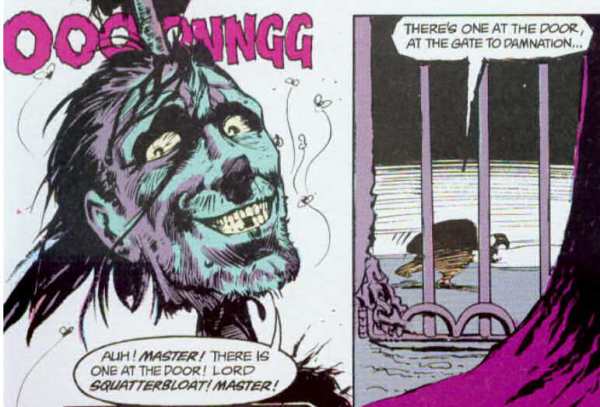
Right from the start where Squatterbloat’s ‘There’s Always One At The Door’ routine is done flat and functional, you just knew this was not going to deliver. The original is a lovely parody of another parody – Shakespeare’s very own ‘The Porter At Hell’s Gate’ comic relief moment within the horror of Macbeth.
It takes superb writing for a character to have but one moment, yet be memorable, and this one delivered in spades. From the smiling rotting head ignoring the flies to call obsequiously to a nightmarish demon who quickly transpires to be every jobsworth gatekeeper there’s ever been in existence – right down to creating his own self-amusing ditty as he goes to perform his sole mundane duty with all the friendliness of a chav’s shark-on-a-lead dog – it is brilliant, brilliant writing, which deserved better than the treatment it received from Martyn Ford, who despite also getting the lines of another character merged into his own, that of the far more subtly malicious Etrigen (the former demon of the wizard Merlin), he may as well not have bothered turning up to play his lines.
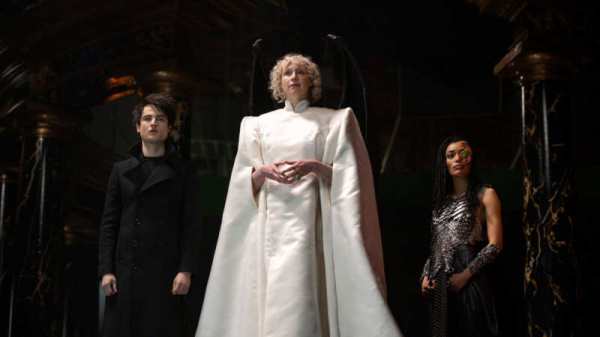
This flat treatment of the material characterises the whole episode, what ought to have been one of the blockbuster moments instead became bargain bucket. Gwendoline Christie’s Lucifer was a complete disgrace and she was certainly guilty of not bothering her arse trying. Everyone know what’s she’s capable of from her outstanding performance as the chivalric Brienne of Tarth in Game Of Thrones. Instead it seems she knew only too well she was chosen for a bit of genderbending and could collect her fee no matter how keck her performance – and, oh, what a let down the end result!
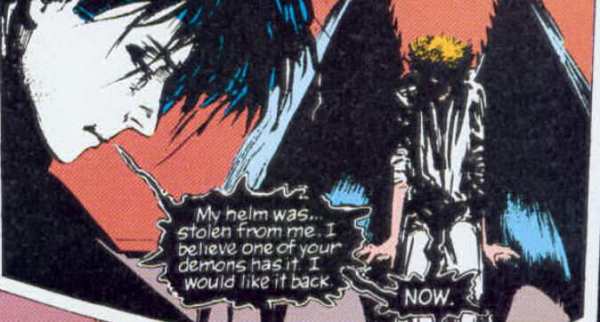
The initial meeting between Lucifer Morningstar and Dream is one of The Sandman’s masterpiece set-plays – polite and cautious in the former (which to anyone familiar with Devil lore would have raised an eyebrow), terse and formal in the latter until the delivery of a subtly threatening ‘NOW!’
Yep, the Lord of Dreams has just delivered an ‘or else!’ to Satan no less – one of those delightful moments of ‘things are not always what they seem, put your preconceived notions to one side’ which The Sandman excelled at: taking well worn cultural ideas and bending the rules without breaking them.
In this particular case, we swiftly find Lucifer piece by piece having to confess he’s no longer the grand dictator of Hell (after one lost battle too many) is another beautifully written sequence butchered by bad adaptation and couldn’t care less delivery – Lucifer indeed even remains Hell’s autocrat, rather than being part of a triumpherate with Beelzebub and Azazel.
The demon Choronzon (whom Dream is forced into a battle of wits for his helm) looked and sounded stupid enough to be a Sims 4 player, rather than the smart double-mouthed smart-ass antagonist with affectations of ‘coolness’ in the comic. The formal challenge sequence was monotonous when it should have been an opportunity to really let the CGI let rip into What Dreams May Come and The Lovely Bones reality bending, and the battle’s aftermath forgettable (even though Lucifer attempted a double-cross of their guest). One could almost call the depiction sinful.
A Fate Worse Than Death’s
But the real deal breaker for many before the show even came out – to others a ghastly portend of the farrago to come – was the actress cast to play the second most important character of the entire The Sandman series – and one of the most important in comic history.
The psychopomp of Death has been one of the great staples of human literature and art for millenias, but only a select few have risen to noteworthiness (and a billion copycats) in their own right – indeed only three in the last century have risen to become definitive archetypes in their own right: the enigmatic chessplayer of Bergmann’s The Seventh Seal ; Terry Prachett’s booming Time Lord style Grim Reaper in The Discworld series where – like The Sandman – no trope however sacred was safe; and Neil Gaiman’s Siouxsie hairdoed sweetheart – who completely threw out the rulebook.
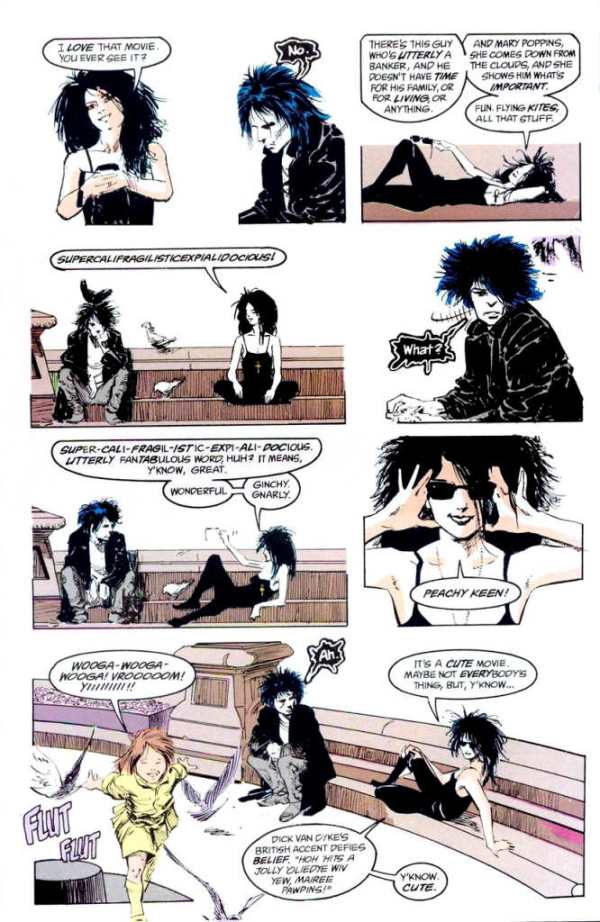
First appearing in the series finale ‘The Sound Of Her Wings’ to the first Sandman graphic novel, Death completely stole the show. Appearing as the stereotypical doom laden morose Goth chick, this Death was charming, kind, witty and utter, utter fun – the all-wise sibling everyone wished they’d had to grow up with; the antithesis of the ominous persona of Death that had reigned supreme up until that point in the zeitgeist – and the epitome of that ‘Hope’ which Morpheus spoke of when he won his battle of wits in the plains of Hell with Choronzon.
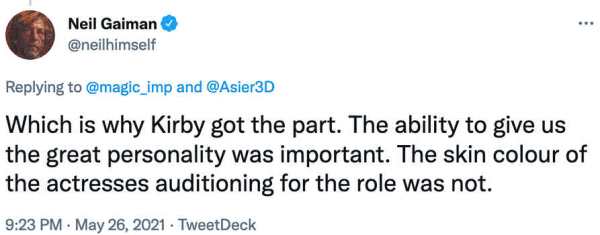
You don’t mess with a cultural icon, least of all in its screen debut, and that Gaiman had decided without warning to give the part to someone who didn’t look remotely like Death (whereas Dream looked exactly the same as they did in the novels) was never going to end well as fans of the books saw what amounts to the worst aspects of Uncle Tommism.
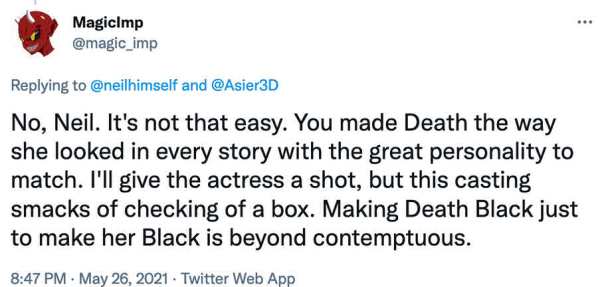
There was already a long overdue backlash under way from Black Whines Matter’s transparant attempts to evolve into another American Humane Society style bunch of shake down hucksters, upon whom everything on screen would be dependent on their blessing to ever be ‘allowed’ to make it to public view – little more than moralisation protection racketeering – and the notion that one of the most inclusive bodies of work was kowtowing to it under threats of being called ‘racist’ was a red rag to a world of bulls.
Especially since, as per usual, the race hustlers in question demanding ‘positive discrimination’ was one – just like whitey- already ludicrously overrepresented visually in TV and film at the expense of just about every other.
A number of fans were particularly angry at Gaiman because the physical characteristics of Death were modelled at his request by a girl called Cinamon Hadley – whom had died only a few years earlier at a tragically young age from cancer.
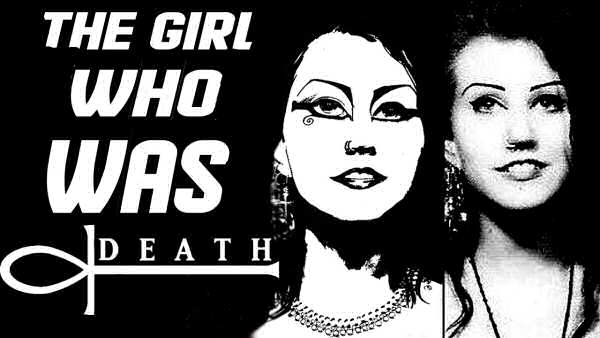
It seemed to them an open slap in the face not merely to the fanbase, but also to the memory of someone whose trademark look had made him very rich. Some even snarked that if Gaiman felt so strongly about representation, why had he not made the title character black as well … the character whom in the books bore a remarkable physical resemblence to Gaiman himself.
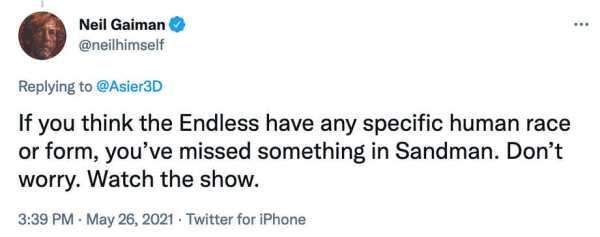
What made matters worse was that Neil Gaiman was just about to be hanged, drawn and quartered by his own petard from only two years prior.
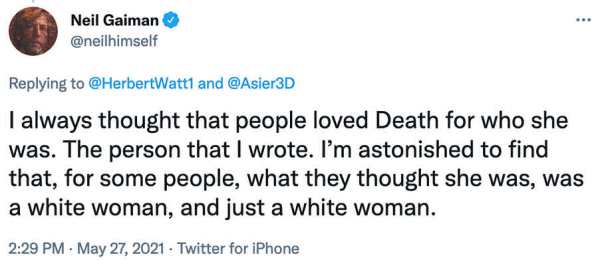
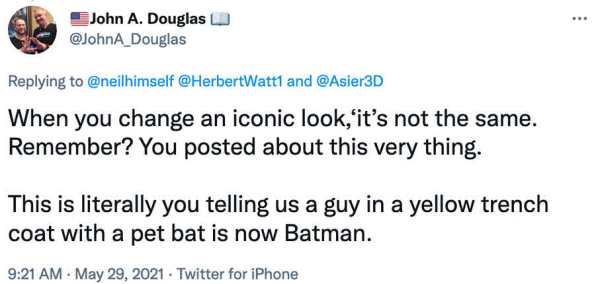
The interview in question John A Douglas is referring to?
When ‘The Sound Of Her Wings’ came out, it was everyone’s worst fears come true.
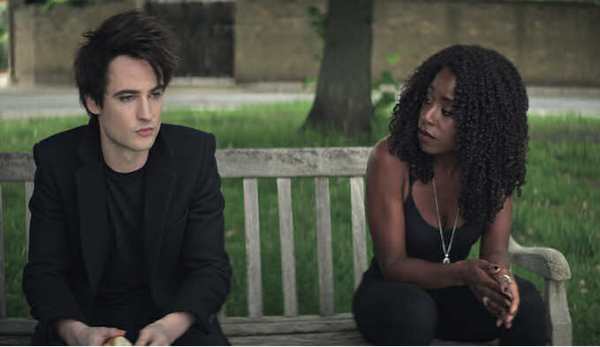
Kirby Howell-Baptiste wasn’t just bad, she was spectacularly bad. Yes, these were big shoes to fill, but she played the part as convincingly as an infant shuffling around in her mum’s stilettos pretending to be a grown-up. Skin colour was just about the least of the show’s worries, here was a thirty five year old purporting to be a nineteen year old (physically …) and whose only long term TV role or major part had been five years before (Killing Eve).
It was a recipe for disaster from the start, and so it proved, as Howell-Baptiste’s sing-song delivery and emotional nuances of dried suet would have been unacceptable in a school play, never mind a season’s flagship production’s top co-star character.
They even cut out Death’s impression of Dick van Dyke’s atrocious attempted Cockney accent mangling ‘It’s always a jolly holiday with you, Mary Poppins’ – because Howell-Baptiste hadn’t the talent to do it … in which case why the devil’s spotty bottom did they employ her in the role?
‘The Sound Of Her Wings’ was a disaster: played through with much the same box-ticking of the key moments with barely any feel for the material (one of which was a cot death for pity’s sake!) This was an episode about death for crying out loud – it demanded some gravitas, some extra special effort on the part of the players. They didn’t even try.
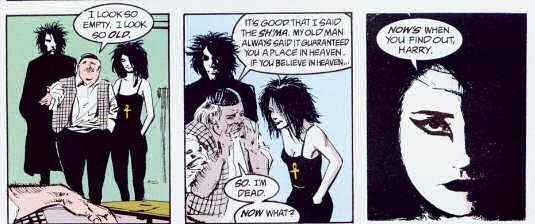
This ought to have been an episode both emotionally draining and utterly uplifting – just like the original, which received so many plaudits (its publishers were overwhelmed with letters of support from not merely people who had lost loved ones, but those who were terminally ill) that Gaiman found himself forced to give Death not merely another outing all of her own come ‘Dream Country’ in the next series of stories, but several spin-off comics as well. She even was a central plank to the AIDS Awareness campaigns of the late 80s and early 90s.
That’s how big an impact The Sandman’s Death had, and that’s why the treatment of her in the show is unforgiveable.
The last four episodes concern the second graphic novel The Doll’s House, and in all honesty I’ve lost the will to bother with it after the first dull episode. White blonde main character becomes black character? Trans character’s off stage actions in the book instead become a full tortuous fifteen minutes worth of them attention whoring? It will please social justice warriors with perpetual chips on their shoulder and their self-flagellating ‘allies’ who think the ignorant peasants need 24/7 education in RightThink at all times, but not the vast majority of the sane population who are bored to death with their entertainment becoming North Korean style indoctrination instead of a little thoughtful escapism from a shitty world.
That there’s talk about ‘cancelling’ the character of Thessaly – another who made such an impact she merited her own spin off series – for being ‘transphobic’ sums up the artistic eunach which Neil Gaiman has succumbed to for cash.
Netflix’ The Sandman deserves to flop. Stick to the graphic novels – for all their faults, they’re more worth your time.


 AA42
AA42 AA6x7
AA6x7 The Mare's Nest
 6s & 7s
 Skeletal Screams Blogspot
