75th Anniversary Of Flight 19 And The Birth Of The Bermuda Triangle Myth
At 3.40 pm 5th December 1945, on a routine training mission from Naval Air Station Fort Lauderdale, Florida, Flight Instructor Charles Taylor decided the flight of five Grummen Avenger torpedo bombers he was in charge of were lost when in fact they were on course.
Taylor had not wanted to take the mission that day for reasons which remain unproven. What is known is that another scheduled member of the flight, Corporal Allan Kosnar, used having flown his allocated number of hours of the month in order to be excused from the mission. He has never given a satisfactory explanation as to why.
What followed was one of the worst disasters in the history of the United States Navy.
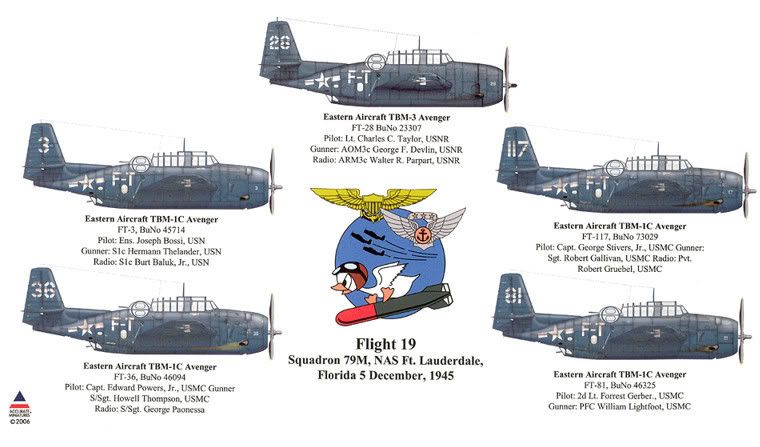
Fourteen airmen lost their lives – their bodies nor planes having ever been found – along with a further thirteen members of the search party sent out to try and rescue them in horrific weather conditions including 80 mph headwinds.
Over two hundred planes and seventeen ships from Florida and the Bahamas went out braving high winds and heavy seas in a vain attempt to find any trace of five small planes ditched on a dark, stormy night.
One search plane, a Martin Mariner, exploded – a type which had already been a cause for concern during World War Two due to its tendency to leak gasoline fumes inside the fuselage. It was in fact lost before Flight 19 had even ran out of fuel.
The inquiry that followed proved a classic military fudge, partly from pressure from Taylor’s grieving mother (who ‘worked’ the newspapers to make sure her son ‘the war hero’ was exonerated from any blame), partly from the potential for a major scandal.
Taylor had already got lost and ditched in the sea after running out of fuel TWICE over the previous eighteen months. The first occasion on June 14, 1944 off Trinidad, the plane sank before they got the raft out, and the depth charges it was still carrying blew up beneath them – it was only sheer luck they weren’t killed.
The second occasion, January 30, 1945, he and his passenger ditched in the ocean in a storm after he was unable to find Guam: a mere 210 square miles in size and the largest island in Micronesia. Again, it was only by sheer luck the USS Bailey found them the next day before the waves claimed them.
It was the sheer bad luck of Naval Air Station Fort Lauderdale that Taylor was transferred to them via NAS Miami where he’d been transferred to after the Guam incident – never mind being trusted with the lives of trainee air crews.
NAS Fort Lauderdale already had a dubious track record of deaths: eighty one trainees were killed between 1942 and 1945: even in wartime this was unnaturally high. The Flight 19 disaster was the final nail in the station’s coffin, it was closed and hastily sold off to the local authorities to use as a civilian airport. One matter which only came to light decades later was due to the Florida sun beating down on the planes’ dark blue fuselages, the rubber rafts inside Avengers melted, making them usuable. This may have contributed to the station’s abnormally high death toll.
Taylor had also confused the radio towers early on attempting to help him by continually stating the flight’s call sign as being MT-28 – indicating it was from Miami. Flight 19 was FT-28 – and this was only discovered by by chance by the increasingly distressed radio operators trying to guide the flight to safety, only to find Taylor refused to follow their instructions to head west.
Taylor also told radio operators that both his compasses were not working – but he could easily have handed control of navigation to one of the other planes. Taylor had only transferred to Fort Lauderdale on November 20 and had never flown the designated area before: the trainees had.
Yet Taylor continually refused to let another plane take over leading the flight. It’s hard to escape the conclusion Taylor feared he would be fired and demoted if he failed to bring the flight back home himself, relying on military discipline preventing the other four planes mutinying and changing course themselves to what radio transcripts indicated they knew to be the correct one. Two of Flight 19 were Captains, E. J. Powers and George Stivers, and could have pulled rank to take over the flight.
One of the tragedies of Flight 19 was two of the crew members were heard by the radio towers saying at 5pm, “if we could just fly west we would get home.” One hour later, the sky was pitch black, and the flight heading to certain doom twenty minutes later.
There was however one postscript. A final faint radio transmission was heard over an hour after they all should have run out of fuel, repeatedly calling ‘FT … FT …’: appearing to indicate that Lieutenant Forrest Gerber’s plane – the one Corporal Allan Kosnar has missed and not been replaced, had mutinied at the last minute and not ditched with the other planes as instructed, taking advantage of the extra fuel it had left from its reduced weight to continue flying, but too late to have enough fuel in increasingly stormy conditions to reach land.
The main reason Flight 19 was lost was down to Taylor breeching the main purpose of the mission: dead reckoning navigation. This is where pilots rely only on instruments to plot their course. The radio transcripts from the flight indicate Taylor became convinced they were lost from what he was seeing from his cockpit window – which in failing daylight can be highly deceptive, especially to a pilot in strange surroundings.
Flight 19 passed into legend, as pulp writers used it as the ‘lead story’ in what grew to become the myth of the ‘Bermuda Triangle’ as a place where ships and planes mysteriously vanished without trace. For anyone interested in that topic, please consult research librarian Lawrence David Kusche’s The Bermuda Triangle – Solved (1975), which you can download for free all over the freaking internet, and which debunks the whole business in a concise, damning manner. His follow up, The Disappearance of Flight 19 goes into more detail into the tragedy which sparked the silly Bermuda Triangle tin hat industry in the first place.
Today, Flight 19 is commemorated at the Naval Air Station Fort Lauderdale Museum at the edge of the nearby international airport.


 AA42
AA42 AA6x7
AA6x7 The Mare's Nest
 6s & 7s
 Skeletal Screams Blogspot
