If You Think A United Ireland Is A Good Idea, You’re Away With The Leprechauns
It’s not even spring yet, but already comes the first cuckoo – Matthew Parris in the Sunday Times with the following rubbish:
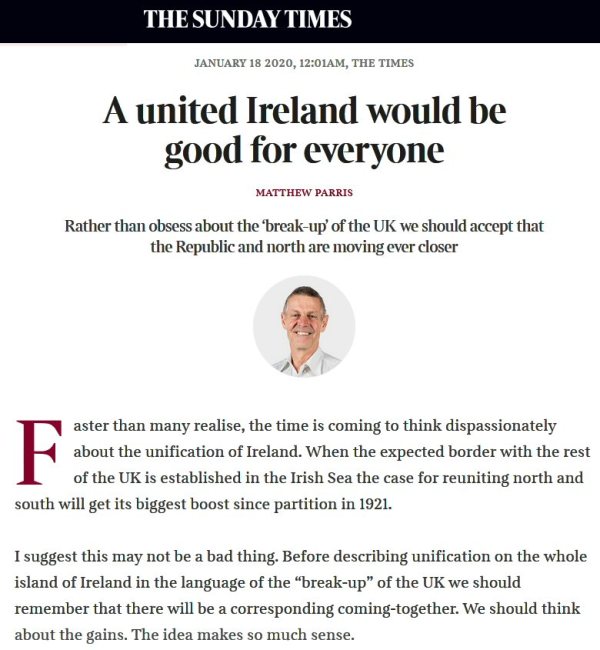
If there’s ever a topic in the British Isles more guaranteed to be devoid of common sense and pragmatics, the unity of Ireland is top of the list. Matters aren’t helped by Americans with a kitsch view of Ireland claiming ancestry and sticking their nose to a topic most haven’t a bollocks about – funding exactly the sort of evil gangsters they decry Iran for doing elsewhere in the world.
Much of the problem comes down to history – or rather the complete and utter refusal of 99.9999999999999999999999999999999999% of the population on the wet and soggy sponge to the east of Great Britain to believe the reality of it.
In the nonsense world of the Irish, theirs was a peaceful and pastoral united land of bards, farmers and scholars since the days of High King Brian Boru, until invaded by big bad England in the 12th century. Come the 16th century, there were the ‘plantations’ and the dispossession of Irish Catholic farmers with mainly Scots Protestant ones, particularly in the Northern province of Ulster. Despite an uprising in 1798 led by Wolfe Tone, English and then British hegemony continued.
It was the 1845 to 1852 potato famine, worsened by high rents forcing many to sell their food and either dying or having to leave Ireland, which was the final straw. After this, agitation for Home Rule increased until in 1916 came the abortive Easter Rising in Dublin by the Irish Republican Brotherhood. The British executed all the ringleaders, and such was the outrage that by 1922 and two bloody civil wars, Ireland became independent, except for six Protestant dominated counties in the north which became Northern Ireland.
However, the Catholic minority in the north were so badly treated that they began to hanker for reunion with the south, leading to the so-called Troubles and terrorism which lasted from the late 1960s until the 1990s.
(And if you think that’s all a crock of shit, just wait until you read your average Northern Irish version of events!)
Now for the facts. Ireland was never a united country. Full stop.
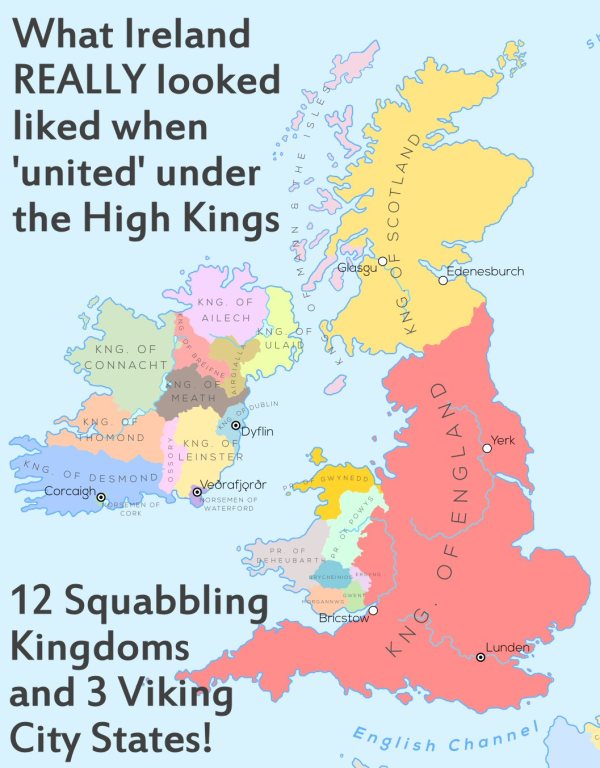
The mythology of a united island of Ireland is based around the concept of its High Kings. At best, a strong High King acted as the overlord over a series of kingdoms. But in reality they were dependent on the backing of enough of the other kingdoms on top of their own, the role was largely ceremonial, and the individual kingdoms largely did as they pleased – including warring with one another. Frequently.
Matters grew worse in the 9th century when the Vikings invaded and set up ports in what today are known as Dublin, Cork, Limerick, Waterford, Wexford and Wicklow. Yes, all of Ireland’s major centres of population were founded by Norse invaders from Scandinavia, not ‘native’ Celts: the headquarters of the Viking sea kings who raided and pillaged Great Britain and France with near impunity for almost three hundred years. Even the very name of Ireland – Eire – comes from the Norse Erinn.
The raids were primarily responsible for the union of the Scots, Picts, Gaels and Britons into Scotland in the north; and the Anglo-Saxons, Britons and various Celts in the south into England. The factions were forced into union in the face of a common enemy which – unlike the Romans before them – appeared hell bent on their extermination after playing them all off against each other.
What concentrated their minds was that each had attempted alliances with Vikings to attack their neighbours – each had discovered the hard way that the Vikings had a habit of stabbing their allies in the back the moment the war was won, safe in the knowledge they could sail back to their lands in Norway, Denmark, Sweden or Ireland with impunity thereafter with their booty of gold and slaves (Dublin was the slave trade capital of Europe at this time).
Eventually a band of Vikings called the Normans from their kingdom of Normandy in north west France were to subjugate England in one of the most brutal conquests of the age – it learned the hard way from the Vikings why control of its moat was important for its safety, and Scotland only escaped a similar fate by the skin of its teeth.
Ireland meanwhile carried on with the Celtic kingdoms and Viking sea lords squabbling over the spoils – except in Ulster where the ruling O’Neills managed to keep the Vikings out. They’d had the advantage of being part of the kingdom of Dalriada which had included part of Scotland – until much of that part was lost to the Viking Sea Kingdom of the Isles (today’s Inner and Outer Hebrides, Shetland, Orkney and Isle of Man) and what was left decided to throw their lot in with the Picts.
By this time, the southern Vikings and their sea kingdoms had merged with one or another of the Celtic ones by dynastic marriage and so no longer posed a threat within the island of Ireland. But this was to be the running theme of the island of Ireland’s history – the O’Neill owned northern territories being at different points (and at times loggerheads) with its southern neighbours. They came to terms with their Viking invaders, the O’Neill north did not, and never trusted them, with good reason.
Pontifications
Come 1155, Pope Adrian IV (the only English born pope) gave England’s Henry II (also Duke of Normandy) the right to invade all Ireland as the Irish Catholic church was not following correct ecclesiastical procedures. Now for the punchline – he didn’t. The idea of invading a cold wet soggy land whether neighbouring settlements – never mind neighbouring kingdoms – were perpetually at each other’s throats simply to please the pope didn’t agree with even the capricious Normans one bit.
But in 1189, the king of Leinster, Dermot MacMurrough, was deposed and exiled in England asked for help getting his throne back. Henry II eventually, and very reluctantly agreed, but only if those knights dumb enough to go on what he thought was a fool’s errand were granted lands in Ireland if they succeeded.
However, they succeeded with alarming haste – Irish warriors were no match for knights with chainmail and English infantry with chainmail and Welsh longbowmen.
MacMurrough promised one of the English-Norman knights, Earl Richard ‘Strongbow’ de Clare of Pembroke, his daughter’s hand and his kingdom of Leinster upon his death. Strongbow was one of history’s most colourful characters – despite being regarded what today would be described as effeminate at minimum, camper than a Rocky Horror show production at maximum, Strongbow was both an excellent soldier and – a complete novelty for Ireland – a man of highly chivalrous values.
The Irish liked him. A lot. In fact, he was just about the only reason the Irish in Dublin, Wexford, Waterford and elsewhere didn’t try again to be rid of the MacMurroughs, who were as bad as it got.
Suffice to say, when Dermot MacMurrough died, his sons claimed the Leinster throne – despite what had been agreed before with Strongbow. Unfortunately, there were plenty in Ireland who wanted Strongbow as king – and some who even wanted him as High King. Word got back to Henry II, and someone began to feel just a little bit threatened.
But Strongbow smoothed things over with Henry, made it clear he’d no intentions of becoming a rival king over the sea, and so they did swapsies – Henry II was given all the land Strongbow held in Ireland, and Strongbow was given equivalents in England and France. To further cement the deal, William the Marshall – regarded as history’s most chivalric knight, married Strongbow’s daughter. The Irish were delighted with this, seeing it as an opportunity to ensure the land was kept at peace, and that – as they say – was that.
Until King John came along – you can guess the rest (ironically, he was also the only person to lead an Irish army to victory over an English one, which again did little to help). Thus began Ireland’s deteriorated relations with England.
When the Tudors came along and started fighting with the French (allied with the Scots – who had invaded Ireland before in an attempt at conquest) and later the Spanish, ensuring England’s western borders were secure became a priority and so began its slow piecemeal conquest and plantation with loyal natives, which contrary to the myth was nothing new in medieval to early modern Europe, where the nobility would think nothing of uprouting some of their peasants and by persuasion or coercion move them to their newly acquired territories. In fact one of the biggest areas of plantation was in Munster (South West Ireland), which of course voted unanimously to be part of an independent Ireland when the time came – so again, so much for the other great Irish myth that those in the north not wishing union with the south are nothing more than ‘colonists’.
There in itself lies the greatest irony of all, that Ireland was only ever politically united as a vassal state of the United Kingdom, and even then up to a point, with some tiers of political and economic power concentrating in Dublin, some in Belfast – no coincidence both just happened to be on the east coastline closest to the British mainland.
As with much to do with Irish history, independence had much to do with contemporary expediency (ie. the fall out of the largely unpopular Easter Rising until Welsh bigot Lloyd George brutally executed the participants, most of whom would have been murdered by their own people if set free, and two subsequent ugly civil wars), and how ‘independent’ Eire ever was in its hundred year history is a matter for some debate.
For all its years in the Common Market/EU, it is still as largely dependent on trade with the British mainland as it ever was, and only a bailout from the Bank of England during the Credit Crunch prevented many of Ireland’s financial institutions from collapsing (which as they owned such massive stakes in them anyway and thus had a vested interest, equally gives the lie about the country’s financial independence when under control of the finance house of the British crown, independent or not). Whatever Ireland is, the ‘Celtic Tiger’ economy of legend was always just that – a legend. Like the Isle of Man and Channel Isles, it was short termism based on the folly that economic realities are immutable.
That was then, this is now
The pro-Republican Irish Times reported on 8th December 2018 that Britain wouldn’t wish to continue to subsidise Northern Ireland when it cost £10.8 billion annually in comparison to £8.6 billion for being in the EU.
Those figures were embarrassing: the real figure is an eye watering £20.6 billion. However, once tax revenues are returned, the net amount is £8.8 billion, a little more than what Britain pays to subsidise the failed state of Poland’s continued existence.
Nevertheless, Northern Ireland has long overstayed its welcome within the UK in the eyes of the vast majority, who would happily cut adrift what they see as a failed statelet of feuding Billy Bobs (or rather Billy Boys) so stuck in the past it’s like one of those annoying reenactment events or historical villages where no one ever, ever, breaks character.
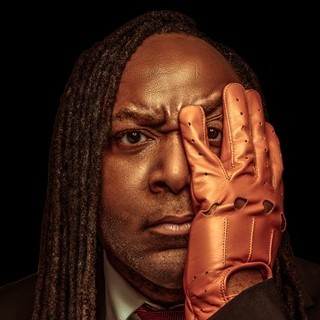
The black American comedian Reginald D Hunter’s anecdote about his visit to Northern Ireland sums up how most people in Britain feel about its last unwanted legacy from its colonial past.
He was in Belfast one Twelfth of July (the day marchers of the ultra-Protestant and very anti-Catholic Orange Order march to celebrate William III’s victory at the Battle of The Boyne – just don’t tell them his Irish campaign was largely bankrolled by Pope Innocent as part of the League of Augsburg/Grand Alliance’s attempts to stop French King Louis XIV conquoring Europe), and wandered into an area where the locals were busy throwing all manner of disgusting objects at those passing by wearing frilly orange sashs (which in other parts of the world would probably constitute a Gay Pride march, but in Northern Ireland and parts of Scotland have an altogether less lighthearted tone).
The reason for such direct manifestations of objection was the insistence of these marchers of parading through areas where most of the residents are ‘nationalist’/’republicans’ (a cue code term for ‘Catholic’) to rub their noses in it. Ritualised confrontation turned into a bizarre bloodsport, and all regarded as good clean family fun all round.
However, all of a sudden – in a scene resembling the famous 1993 Peckham Riot in the comedy show ‘Only Fools and Horses’ – the throwing of obscenities, never mind objects, ceased whilst the music and marching continued unabated. Hunter watched amazed as a troop of black Orangemen – from Nigerian and Ghana – passed by.
To pause for explanation for a moment, Black Orange Lodges are a throwback from World War Two, when Black servicemen in the UK and Northern Ireland could not be served in the same bars as white American GIs. The latter would object, usually in a threatening tone, and the result was usually a mass brawl with the locals firmly on the side of the black servicemen – the ordinary British public’s attitude towards its black and Asian Commonwealth soldiers as heroes was in marked contrast to the U.S’s towards people from the same cities to whom a non-white skin meant second class citizen). However in places such as Liverpool and Belfast any black serviceman or woman could safely order drinks in any Orange Lodge as they were assumed – incorrectly – to be all ‘good Protestants’. It’s only been in the last decade however that lodges made up of largely non-white members have been invited (and often subsidised) to attend the Boyne parades as part of the Orange Order’s public relations with the rest of the world not to look like the bunch of bigotted inbred rednecks everyone takes them for.
To return to Reginald D Hunter, the moment the black marchers passed, battle recommenced. More than a little confused, he asked for an explanation, and was told (with a less than subtle hint of people who ask questions are the sort of people who don’t belong here) that they never threw or shouted anything at the black marchers because they didn’t want the world to think they were racist.
Apparantly Reginald D Hunter was on headache tablets afterwards for a week. Most of Britain has regarded Northern Ireland as a century long headache, and in the words of Belfast’s Stiff Little Fingers’s song ‘White Noise’, most would wish someone would ‘tow it out and sink it!’
Ireland hasn’t got anywhere near £20 billion to throw away in the direction of Northern Ireland in the hope of getting most of it back – as an area which has allowed foreign multinationals to get away with paying next to nothing in taxation in return for giving the natives slave labour jobs with wage slave wages, its dependence on EU handouts for infrastructure improvements is legend – money which largely came from the now ceased UK’s block contribution anyway.
The danger is Ireland’s youngsters brought up on a hundred years of lies from grandpappy’s lap to the schoolroom about everything wrong in Ireland being somehow ‘Britain’s fault’ (Ireland never had anti-Semitism to any degree because it already had a whole British conspiracy theory apparatus in place for its ubiquitous scapegoat) and those with one foot in the grave who know they’ll never have to live long through the consequences of their sentimentalism, will exercise in the current general election an act of electoral folly which will make those Americans election of Trump appear astute, and will continue to do so in increasing numbers thereafter.
The demographics of Northern Ireland also show that a slight but growing majority favour reunification on nothing more than tribalistic (ie. pseudo-Catholic) grounds – despite ‘nationalist’ politicians involved in powersharing proving to be every bit as corrupt and incompetent as those they replaced.
Britain – hardly able to believe its luck having direct subsidising the failed former Warsaw Pact states of Eastern Europe for two thankless decades – would gladly hand it over wrapped in a pretty Orange ribbon and a note saying ‘Enjoy!’ With any luck a sizeable chunk of the hardline bigots will also emigrate to Scotland to dilute down those seeking Scottish independence, which with its massive oil and whisky revenues is – unlike Northern Ireland – worth keeping as far as any British government is concerned.
If they didn’t and stayed, they would simply operate as a block (Ireland’s population would increase by over 25%) to ensure any Irish political party with aspirations to power would need their support to form a government – an effective strangehold leading to the North receiving an unfair distribution of tax resources to the detriment of the original Eire counties.
Either way Boris Johnson would go down as the luckiest Prime Minister in the history of Britain, whereas the incoming Irish Taoiseach who accepted this white elephant with a red hand brand on it would be cursed as a fool forever. Yet, unbelievably, this is exactly how current events appear to be playing out over in Ireland right now. If that sorry soggy land thought it had problems in past centuries, it may be about to wish on itself a plague of problems the like of which it has never saw, and all for the sake of choosing to believe fact over fiction.


 AA42
AA42 AA6x7
AA6x7 The Mare's Nest
 6s & 7s
 Skeletal Screams Blogspot
