Claims About Bideford Being Racist Aren’t Quite As Black And White
One of those moments you despair of the human race.
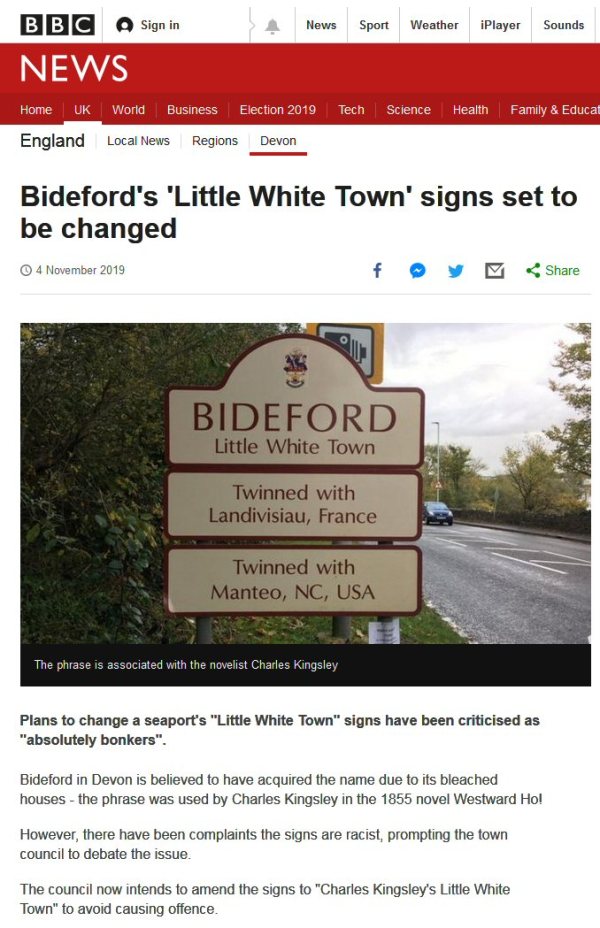
Thanks to a bunch of incomers raising a ‘racism’ issue which wasn’t there to begin with (the usual cosmopolitan commuters or retirees which are the bane of most rural folk’s existences from their arrogant attitude that the existing residents are all ‘dumb yokels’) , Devon County Council’s roads department is going to have to spend money redoing all the road signs going into Bideford – this will come out of the part of the budget allocated to Bideford for routine road repairs.
Former Raving Loony Stuart Hughes will be raving mad – he’s had his work cut out for almost a decade trying to bring Devon’s roads up to scratch, and this is exactly the sort of self-indulgent nonsense cash-strapped rural authorities can well be doing without.
It’s now got to the stage saying anything which is in a different context would be a racial term automatically makes it ‘racist’.
This isn’t combatting racism, this is bullying: looking for offence for the excuse to have your boot on someone else’s neck – before looking for excuses to next put a rope around it.
The Christian churches used to be terrific at this, just to show they could. Certain other religions still have such powers, and it is no coincidence all coincide with the nastiest, most repressive, more backward countries on the planet.
But stopping those morally clubbing everyone else for supernatural reasons – ‘my god says so’ – has only resulted in the skeet vacuum being filled by those doing so for the poisonous ideological reason of ‘political correctness’, and for the exact same motives – having their boots on everyone else’s necks.
In all the places of the world for this to occur, there is an irony to picking on Bideford, ‘the little white town’ so named because all the homes were whitewashed with lime (a common enough occurence in the West Country and other coastal areas where lime could be easily made by burning seashells) in a futile attempt to stop a cholera epidemic (the scourge of the 18th and 19th centuries until modern sanitation caught on). If there was ever a place where it would have its work cut out keeping the buildings white, it would be Bideford – the home of Bideford Black!
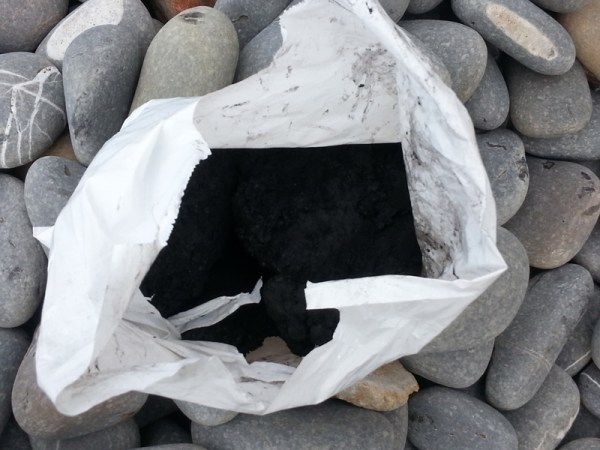
Look at the intensity of that black. It seems blacker than the black you see today, a black from a bygone, gothic age. You’d be right to think so. The chemically produced artificial black pigments you may get today are cheaper, but none can match the intensity of this natural product.
Bideford Black is – or rather was – a pigment which came from the town’s meagre coal seams (enough for Bideford, nowhere else) and lasted longer than the local coal mines did. Two hundred years to be precise. Because of its clay quality, it was especially useful for colouring anything needing to be water resistant.
Boats and the rubber for tyres became reliant on Bideford Black, which made the town prosperous where the mine’s did not. It was used by Max Factor for their trademark black mascara. Australian aboriginals even bought it for ceremonial body paints because it was so durable.
The one problem was after Bideford became the Little White Town, locals faced a constant battle with the residue of the Bideford Black mining blowing in the air and back onto the town, resulting in a constant battle to keep their buildings pristine until the end of the industry in 1968.
Perhaps if those foolish Guardianistas looking for excuses to scream ‘racist’ knew more about the people they were talking at (‘at’, never ‘to’ and certainly never ‘with’!), they would learn matters aren’t always so black and white as they seem?


 AA42
AA42 AA6x7
AA6x7 The Mare's Nest
 6s & 7s
 Skeletal Screams Blogspot
