Films Review: Let The Right One In Vs Let Me In

Boy Meets Girl. Girl Turns Out To Be A Vampire. Aren’t They Bloody All One Way Or Another? Badum tish.
Both Let The Right One In and Let Me In have been reissued on DVD for the bargain price market, so there’s incentive enough to give each a try.
The same story, the same movie?
Not quite.
The same quality? Definitely not.
It’s very much The Done Thing to say the original European version of the movie (or Japanese, Korean, Indian, Burkina Fasoian, etc) is fabulous, genre defining, all the superlatives one can muster.
Whereas the Hollywood version is trash, plays to the lowest common denominator, lacks the subtle nuances which makes the original such a classic.
The usual Guardian reading, cappuccino and latte sipping hipster bullshit.

To be sure, the evidence for the prosecution is damning enough. The Franco-Dutch Spoorloos, one of the most disturbing films ever made, was so badly remade as The Vanishing by the same director, it came as little surprise that George Sluizer confessed later he attempted deliberately to lampoon ‘the Hollywood style’ from annoyance at the studio’s insistence at including every old thriller trope in the big budget rehash. Penelope Cruz was all that was left of Abre los Ojos when it became Vanilla Sky and the Ham Pack of Tom Cruise, Cameron Diaz and Kurt Russell made the proverbial pig’s breakfast out of another script.
Give a Hollywood studio an acclaimed success from a foreign land, and they will turn Le Cordon Bleu into the celluloid equivalent of a McDonald’s Happy Meal. It’s a cold day in Hell when the reverse is true – which is appropriate for two films set in snowy climes, albeit the notion of New Mexico deep in snow takes some swallowing.
During his review of Let Me In, Sukhdev Sandhu of the British Daily Telegraph spoke of Let The Right One In‘s ‘alluring otherness’, ‘brittle textures and haunted ambiance’ in a review that stank to the highest heaven of that inverted racism beloved of pseudo-intellectual journos of the ‘this is better because it’s from a non-English speaking culture’ school – the sort of pretentious shit you’d come to expect from The Guardian, not its arch-enemy the Daily Dreadnought.
It’s clear he never bothered watching Let Me In. For there is no way anyone could watch the two without coming out in favour massively for the Hollywood remake, not even if you’re Swedish.
The basic plot

Oskar/Owen is a school bullied boy in a hick town in a depression estate of apartment blocks. His parents are separated and in the case of the American movie have all the warmth of microwaved chicken. Slowly going off the rails from an interest in serial killers (primarily because he wants to kill the bullies), he encounters Eli/Abby whilst taking out one of his budding sociopath fantasies with a knife out on a tree. She informs him they cannot be friends, but, well, ya know…
Eli/Abby however harbours a dark secret. The man she lives with (in the original a paedophile called Håkan forever hoping she’ll let him abuse her one day in return for his servitude to her, in the American a man called Thomas you suspect is a paedophile throughout the film until you learn the heartbreaking truth later) is her Familiar, the volunteer servant of a vampire.
People start dying. Other people start getting suspicious. In the Swedish version a bunch of Oskar and Eli’s neighbours catch her in the act; in the American version, a local detective starts to realise there’s something more sinister than a local serial killer at work. Eli/Abby, in her desperation for blood her familiar fails to provide, starts getting careless, especially when – in a moment lifted straight from the classic Nosferatu – Oskar/Owen cuts his hand and Eli/Abby reveals her true self. Eventually she’s forced to kill, or be killed, when her familiar dies and she’s left all alone, and so flees town.
Meanwhile at school, Oskar/Owen has put one over the bullies (largely from Eli/Owen’s encouragement). In a banal piece of reality over the fantasy that hitting the bully back makes them pick a new target, they carry out an elaborate reprisal attack on Oskar/Owen to the point he almost drowns – in comes Eli/Abby as the Deus Ex Machina. Good guys win. Bad guys get dismembered; and Oskar/Owen flees with Eli/Abby on a very comfortable looking train to start their new itinerant lives together.
Not so comfortable for Eli/Abby though as she’s locked in a trunk tapping Morse Code to her new Familiar. That’s the problem with these last minute package deals on rail, you might find yourself getting Jeremy Corbyned.
Method of slaughter

Let The Right One In trips up from the start where Håkan, Eli’s Familiar (the person that does the vampire’s dirty work) renders a victim unconscious with halothane before stringing them up to bleed down to a funnel inside a plastic container.
The container is never going to hold even a quarter of the person’s blood, which seems silly considering the risk being taken and how fast a still living person will bleed after having any arteries severed means each kill would be maximised for returns.
But aside from that, the very idea of the Familiar using a general anaesthetic rather than blunt trauma to render helplessness is absurd, and it’s bizarre those choosing to praise the Swedish film over the American have glossed over the original falling for the Hollywood myth of the almost instantaneous incapacitating anaesthetic – that’s before even delving into the technical fact that blood reeking of anaesthetic reeking is likely to make our young vampire as sick as anaesthetised meat would any mortal since such chemical agents tend to turn into something even more unpleasant inside the body.¹
For a vampire or their familiar, speed is everything – making the kill, hiding the evidence and getting away as quickly and quietly as possible. Let Me In at least gets that part right from the start.
Special effects

Much has been made of the ‘minimalism’ of the Swedish original, yet the CGI cat attack – more hilarious than horrific, indeed one of the unintentionally funniest moments of any movie – is far more over the top than anything Let Me In attempts, and the silly Freddy Krueger results of the self-inflicted sulphuric acid in the Swedish version – yes, more horrific and completely unrealistic (did the producer forget pictures of acid attack victims are almost a tabloid staple?) give the impression they’d like to go over the top if they only had the resources of Hollywood.

What Let Me In does in terms of special effects (the inevitable spectacular car crash, the vampire moves at The Matrix speed, etc) at least it does well, and with some degree of decorum. The subject matter is horrific enough. Abby’s transformation momentarily into a vicious killer contasts with Eli, who doesn’t look like she could knock the skin off a rice pudding even when she is killing someone.

The protagonists

But the biggest problem between the two movies is the acting. Forget the language difference – once you know the story line you don’t really need to bother with the subtitles if you can’t understand Swedish (a movie is supposed to show, not tell). The flatpack truth is Kodi Smit-McPhee and Chloe Grace Moretz are far better than Kåre Hedebrant and Lina Leandersson, the latter two having the acting abilities of an Ikea Self Assembly, Kåre Hedebrant being the worse by a country mile.
It’s not ‘minimalism’ when your acting ability has the emotional range of some college coursework piece stuck on You Tube, it’s plain old not being very good – and had this been done by English speaking actors in an English speaking film, they’d have been roundly and rightly slaughtered for it.
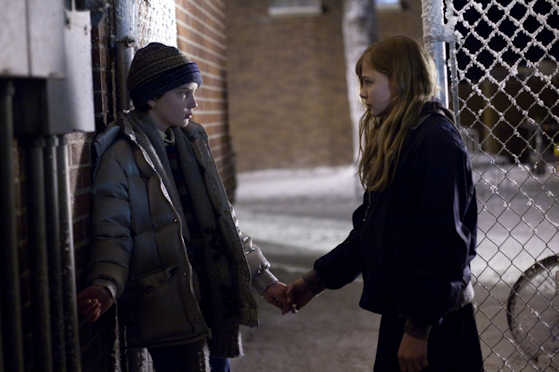
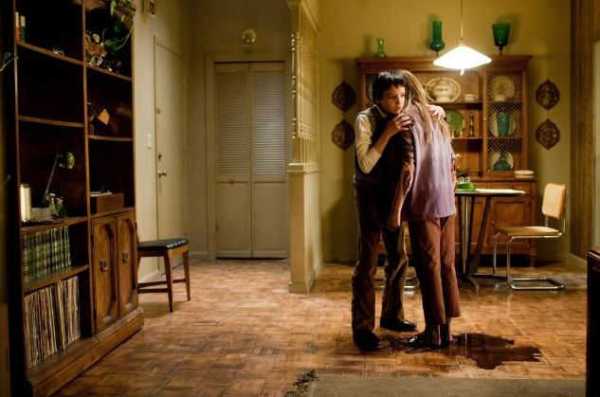
By contrast, anyone failing to shed a tear over Kodi Smit-McPhee and Chloe Grace Moretz’s performances hasn’t any heart in them, with some beautiful moments of pathos, especially the ‘let me in’ scene and the aftermath of the murder in the bathroom when Abby – speaking not a word – puts her arms around a traumatised back-turned Owen that pleads silently ‘please don’t reject me, despite this, please don’t hate me’ – and still ends up running away because she accepts it’s unfair to expect anyone else to share the burden of her cursed existence the way Thomas did.
Little of the main cast for the Swedish original are in fact any good – save for the cat collecting dude and his circle of friends. The bullies have little menace or ability to install any hatred towards their inevitable sticky end denouement – seeing the brightly lit swimming pool tastefully adorned with bloodstains and random body parts, the feeling is, ‘um, that was a bit harsh.’
In the American version they succeed in suspending your credulity to the way Abby tears them all limb from limb (and head from body), let alone your morality that perhaps bust noses and kicks in the nuts all round would have sufficed. Even though they’ve done little different to their Swedish counterparts, in this instance there is the overall impression the world will be a much nicer, kinder place for them not being allowed to grow up in it. You can almost forgive Abby for the evil she’s done before. Almost.
‘Stop stranger, as you pass by. As you are now, so once was I. As I am now, so you shall be. So prepare thyself to follow me.’
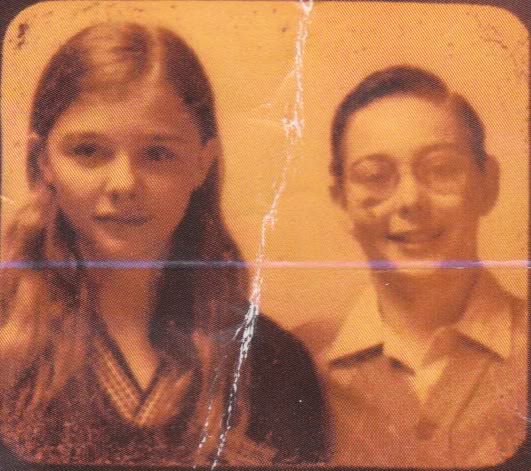
Let Me In also includes that dynamite moment Let The Right One In does not – the photograph of the Familiar Thomas as a young boy with the vampire he loved and ultimately gave his life for, the shattering moment that brings home so powerfully that for Owen this is the life to come should he chose to remain with Abby, a miserable life moving from place to place, always watching for the sunrise, always staying one step ahead of the police, living off what they can scavenge from their victims because holding down a job is of course impossible, until the day comes he too will be too old or too impaired and all he will have left to give Abby is one last meal.
It’s with this in the back of the mind that Abby’s return to save Owen from the bullies (after fleeing because she does not want to ruin his life the way she ruined Thomas’s) is far more powerful than Eli’s in the original. Eli’s reason for return is cold and methodical – her paedophile familiar is dead, she needs a replacement, Oskar will do (despite that he can barely look after himself).
Abby by contrast has spent the entire movie saying and behaving in a tragic ‘go away, I need you’ manner to Owen whom she can promise but a lifetime of misery and apprehension. She knows she’s only going to make him miserable. He was miserable before she came along, true, and will ultimately be even more miserable upon her departure, but at least his school years and the bullying going with it will eventually end, and he will be free to make a new life afresh in the adult world. This the far old Abby knows from experience. She also knows she cannot survive in the world on her own.
She goes with him to the amusement arcade. She tries his sweets when she sees refusing hurts his feelings, even though she knows it will only make her very sick, and apologies to him when she does vomit later – in truth she’s apologising to him for more than a thrown up candy, but for coming in and messing up his messed up enough life and giving him someone to care about in a world that doesn’t care for him.
She tries to fit into his world. Oh, how she tries – even though past experience will have shown her how doomed the prospect is. She wants to be normal again. More than this, she wants to love one of those which to her have merely become dinner. For all that Abby can hand out Whoop-Ass like a pro, she has no protection from a permanent broken heart for her own destroyed life and the lives she is doomed in turn to destroy. Eli by contrast seems nonchalant to her condition, apart from bursting into tears upon killing her first victim in the underpass.
Why New Mexico beats Stockholm
Forget horror. Despite the bloody corpses, despite the dismembered bodies a-go-go at the end, these aren’t horror films.
They’re not even romantic films, despite the tagging. They’re more explorations of the human condition, especially that of need; whether emotional, material, or both at once. This is usually the field European cinema excels and Hollywood embarrasses.
Ultimately it’s what makes the characters within the American version so real, and the Swedish version so utterly flat. There is more said about the human condition between Abby and Owen than between Oskar and Eli – in fact more also said between Abby and Thomas than between Eli and Håkan. The relationship between a vampire and their Familiar is a crucial one, yet in the Swedish original this is barely touched upon despite taking up a sizeable part of the book.
The book the movies derive from may be taken from a song by The Smiths, but the Waterboys song ‘The Three Day Man’ probably has more in common with the plots of Let The Right On In/Let Me In.
People snatch instinctively for whatever crutch they need
But I promise not to abuse you If you don’t abuse me.
That doesn’t mean that I’ll be your slave
It doesn’t mean you’re here to stay
It doesn’t mean we’re friends for life
You know I want you, you know that I love you
But I’ll never need you anyway.
Notes:
¹ In Madelaine Bunting’s history ‘The Model Occupation’ on life in the Channel Islands during World War Two, one family tried chloroforming the family pig they’d kept hidden from requisition by the Nazis, so no passing soldier would hear its death squeals as they slaughtered it. The entire family was rendered extremely ill from the subsequent meal as the anaesthetic turned into phosgene in the carcass, poisoning them.


 AA42
AA42 AA6x7
AA6x7 The Mare's Nest
 6s & 7s
 Skeletal Screams Blogspot
